
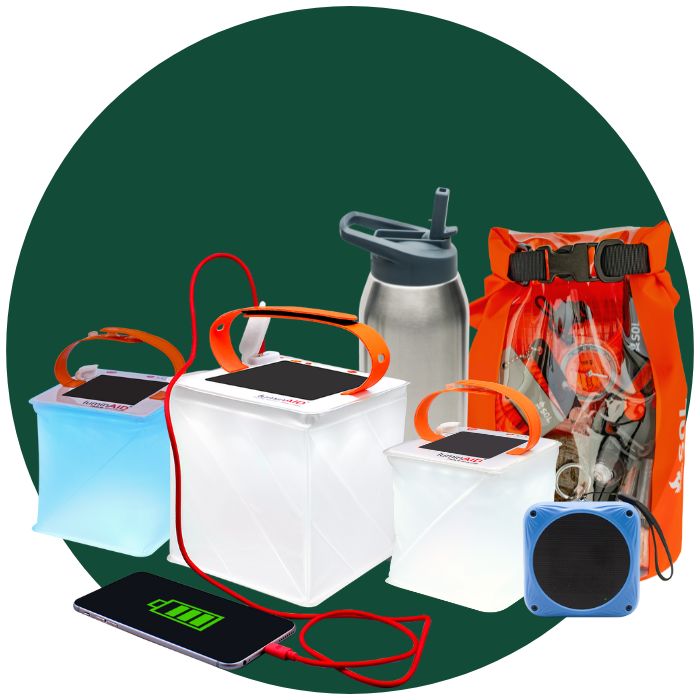
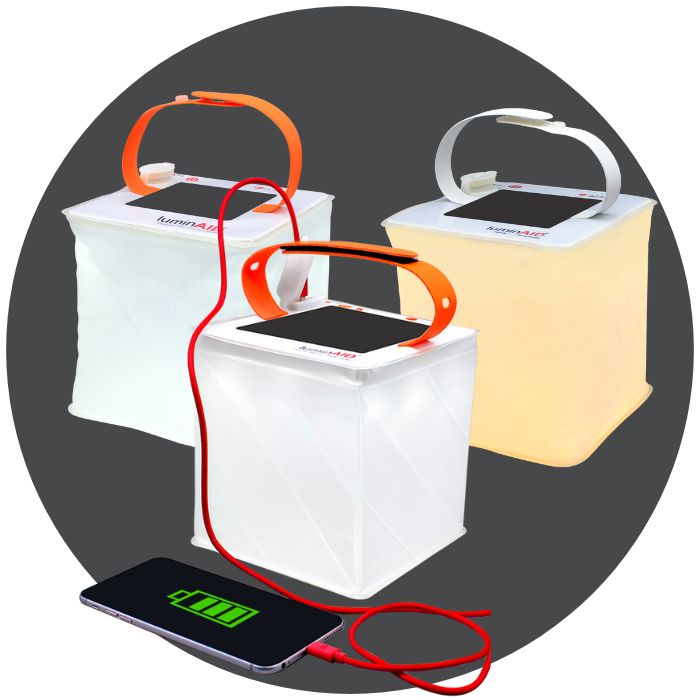


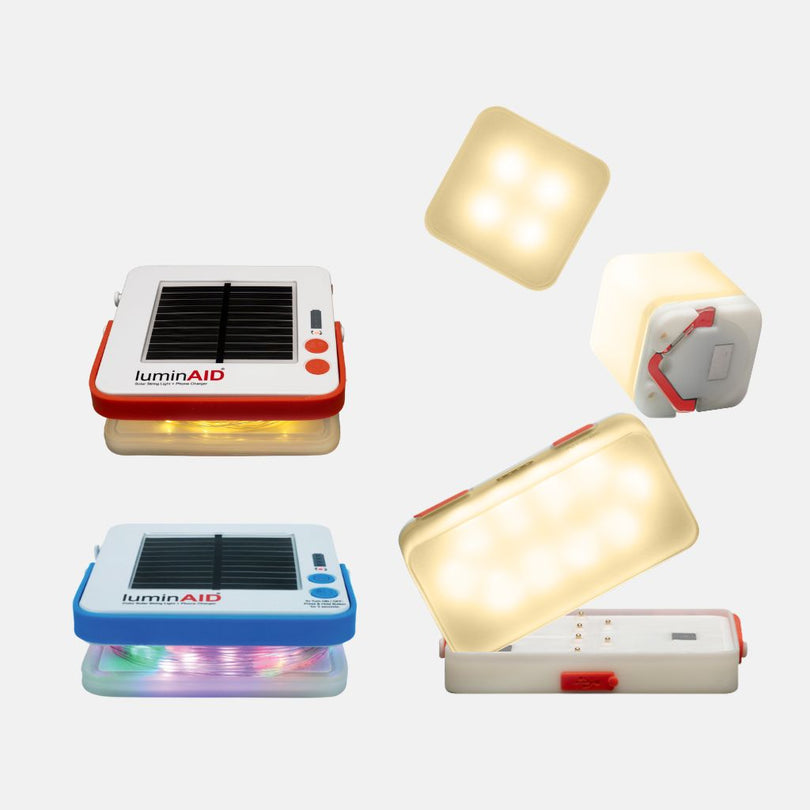


The power goes out after sunset. A phone sits at 12 percent, the room is dark, and finding a charging cable by flashlight feels harder than it should. A phone charger lamp solves that particular problem by combining usable area lighting with stored power for a phone or small electronic device.
The category makes sense for campers, emergency-preparedness kits, backyard hosts, RV travelers, and households that experience outages. The important distinction is that these products aren't judged only by brightness. A useful model must also store enough energy, accept a practical charging input, and keep its USB output available when the phone matters most.
Table of Contents
- What a Phone Charger Lamp Actually Is
- How Phone Charger Lamps Work
- Charging Speed and Battery Expectations
- Key Features to Evaluate Before You Buy
- Real-World Uses for Camping, Outages, and Backyards
- Safety and Battery Care Essentials
- Buying Checklist and How LuminAID Fits
- Common Questions About Phone Charger Lamps
What a Phone Charger Lamp Actually Is
A phone charger lamp is a single portable device with two jobs. It illuminates an area with LEDs, then uses an internal rechargeable battery to send power through a USB port to a phone or another small device. Some models recharge through a built-in solar panel, some through USB, and some offer both paths.
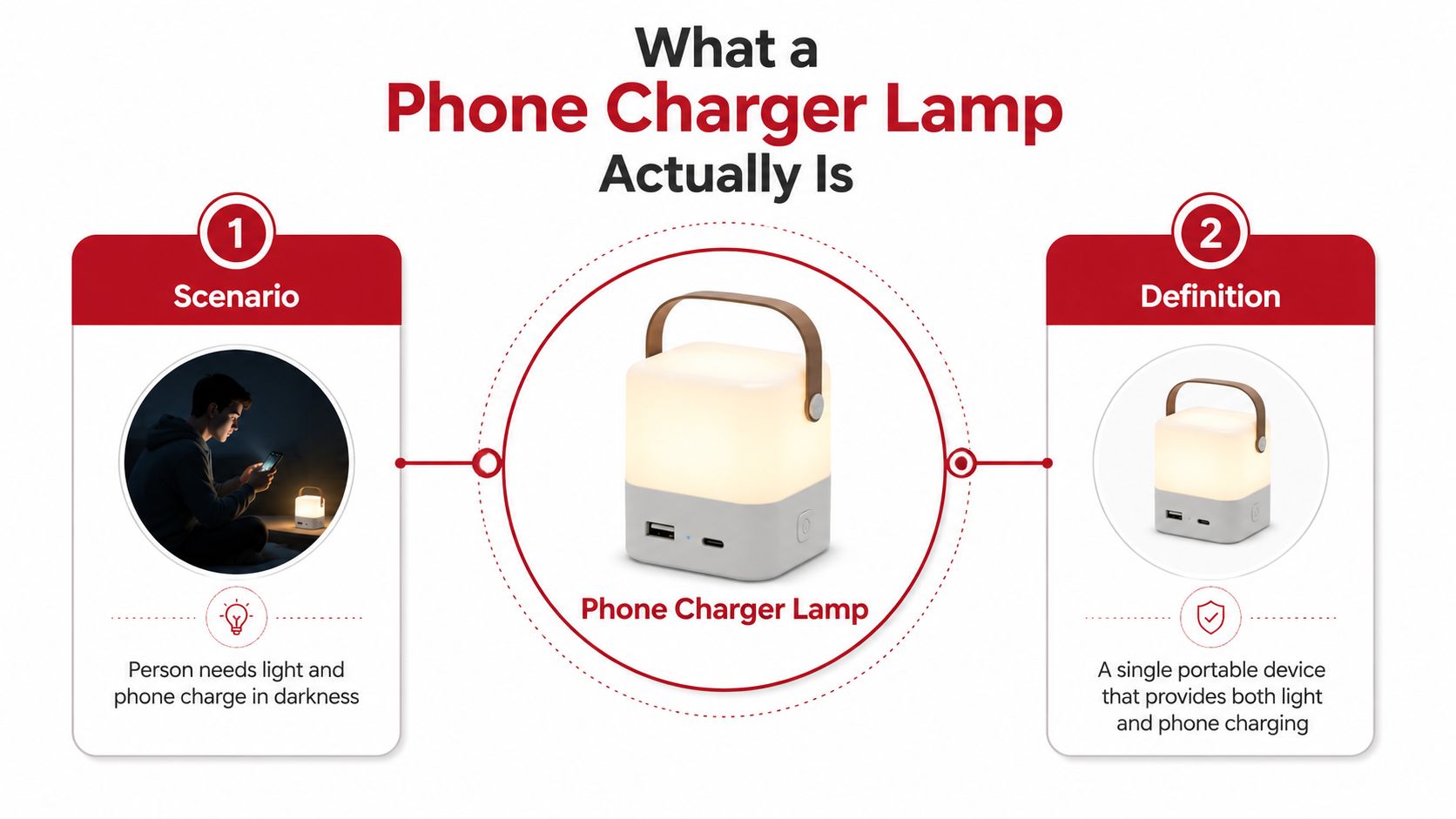
A regular flashlight usually produces a directional beam. That makes it useful for following a trail or inspecting a fuse box, but less convenient for lighting a table, tent, or room. A power bank does the opposite: it stores electricity for a phone but doesn't provide meaningful illumination. The phone charger lamp sits between those products, with a lantern-style light source and a power-bank function in the same enclosure.
Who benefits from the combination
A camper may hang the lamp inside a tent, use its softer light while preparing food, and connect a phone before the next day's route. An emergency planner may keep one in a go-bag for communication during an outage. A backyard host may want gentle table lighting without running an extension cord.
The category also fits people who value fewer separate devices. One unit can reduce packing decisions and provide a fallback when a phone becomes the only source of maps, alerts, messages, or emergency calls. A practical overview of the broader design category appears in this guide to multi-purpose portable light.
The trade-off is shared capacity. The same battery supports the LEDs and the USB output, so a lamp used at high brightness for hours may have less energy left for a phone. Buyers should therefore ask two questions together: how well does the lamp light the space, and how much stored energy remains for charging?
How Phone Charger Lamps Work
The simplest way to understand a phone charger lamp is to treat its battery as a water tank. Solar energy and USB power are two ways to fill the tank. The LEDs and the USB output are two drains. Every decision about brightness or phone charging changes how quickly the stored energy runs out.
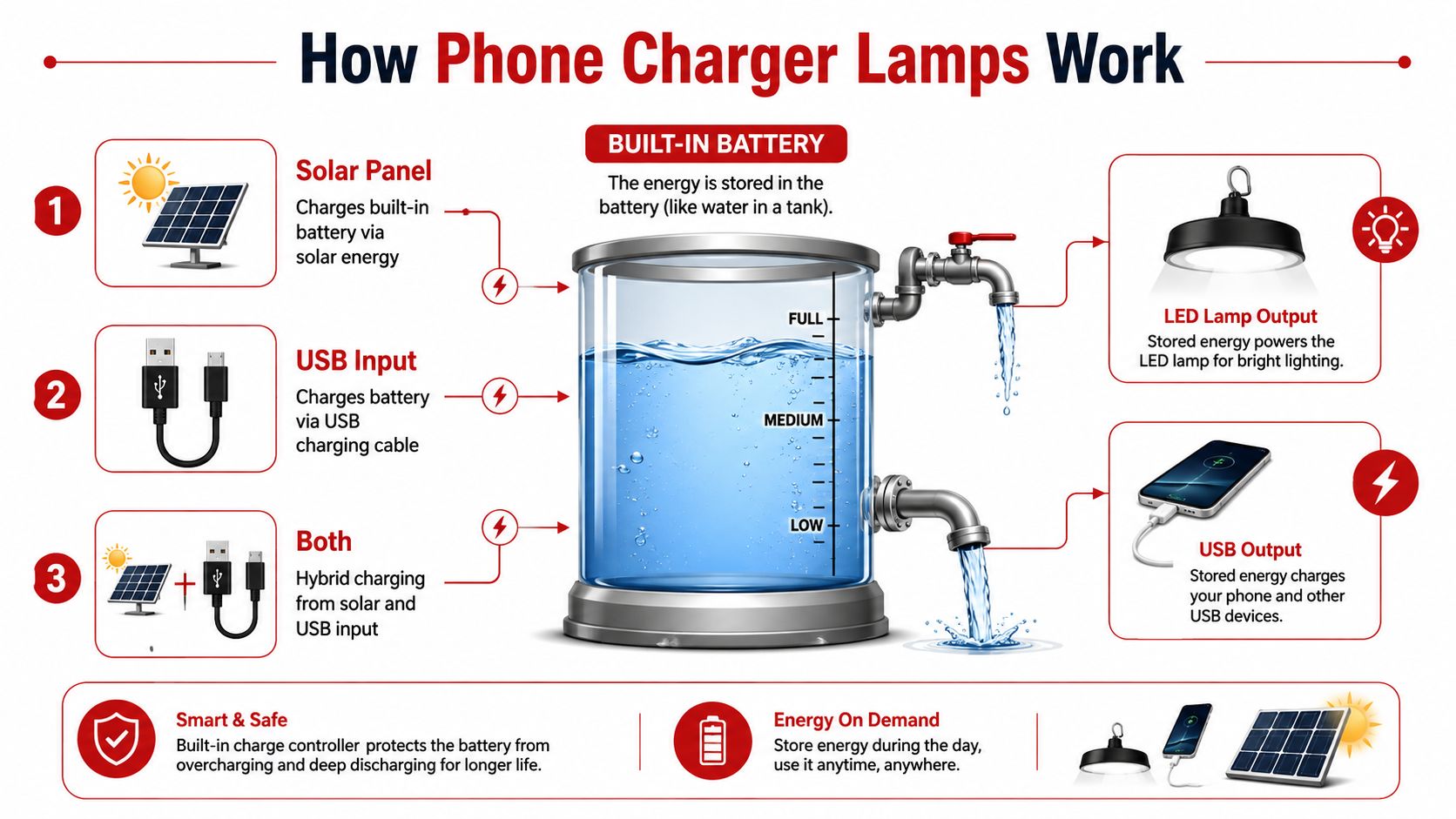
The three charging paths
- Solar charging uses the built-in panel to add energy when the panel receives sunlight. It can help maintain the battery during a trip, but a small panel produces limited power and output changes with weather, season, shade, and panel orientation.
- USB charging fills the battery from a wall adapter, vehicle outlet, power station, or another USB source. This is normally the predictable way to prepare the lamp before camping or to restore it after an outage.
- Hybrid charging gives the user both options. USB can provide the main recharge, while sunlight helps preserve capacity when the lamp is away from an outlet.
Reading a basic specification sheet
The battery capacity appears in milliamp-hours, or mAh, and sometimes watt-hours, or Wh. Watt-hours offer a clearer comparison when products use different voltages, while mAh remains common on consumer packaging. A useful explanation of the conversion appears in this battery watt-hour guide.
The solar panel rating indicates the panel's nominal power, although real-world output is lower or less consistent under imperfect conditions. The USB input rating tells how quickly the internal battery can accept energy. The USB output rating describes what the lamp can deliver to a phone.
Other specifications describe the user experience. LED modes control brightness, color, or flashing patterns. A diffuser spreads light through an area, while a focused mode may work more like a flashlight. Once those parts are understood, the energy flow is straightforward: sunlight or USB power fills the battery, and the battery supplies either the lamp, the phone, or both.
Charging Speed and Battery Expectations
A phone charger lamp is usually a lighting device first and a backup power source second. Solar input is convenient, but it is not fast charging. One independent analysis reports integrated solar input of only 0.3 to 0.75 watts, requiring roughly 15 to 37 hours to recover an 11.1 Wh cell. The same analysis estimates about 2.5 hours through a standard 5-watt USB-C input, or about 1.3 hours through a 10-watt USB-C PD source, after conversion losses. The charging analysis explains the practical difference between solar and USB input.
Solar still has a practical role. During a multi-day trip, daylight exposure can gradually preserve the lamp's reserve, especially when it is not charging a phone at the same time. USB is the dependable choice for a full recharge before departure or after an outage.
For a 4,000 mAh battery, recharge time depends on conversion losses, battery condition, cable quality, temperature, and the charger. These figures show the general relationship, not a guarantee for every model.
| Battery Capacity | Solar, 1W panel | USB 5V/1A | USB 5V/2A |
|---|---|---|---|
| 4,000 mAh | Roughly 20 to 40 full-sun hours | Roughly 4 to 6 hours | Roughly 2 to 3 hours |
Under ideal electrical conditions, the 5V/2A path supplies about twice the input power of 5V/1A. The lamp's internal charging circuit may accept less, however, so the printed input rating is only part of the answer. Charging a phone also loses energy through voltage conversion and the phone's own charging controls.
Practical rule: Treat the solar panel as a way to preserve battery availability, not as the only plan for rapidly refilling a depleted lamp.
Battery capacity often says more about off-grid usefulness than headline lumens. A very bright lamp with a small battery may light a campsite impressively for a short time. A lower setting on a larger battery can leave useful reserve for a phone. Compare the lamp's stored energy, USB input wattage, and expected phone output together, then review solar lantern chargers and power banks as different tools with different trade-offs.
Key Features to Evaluate Before You Buy
A good buying decision starts with the lamp's stored energy and charging path, not its brightest marketing number.
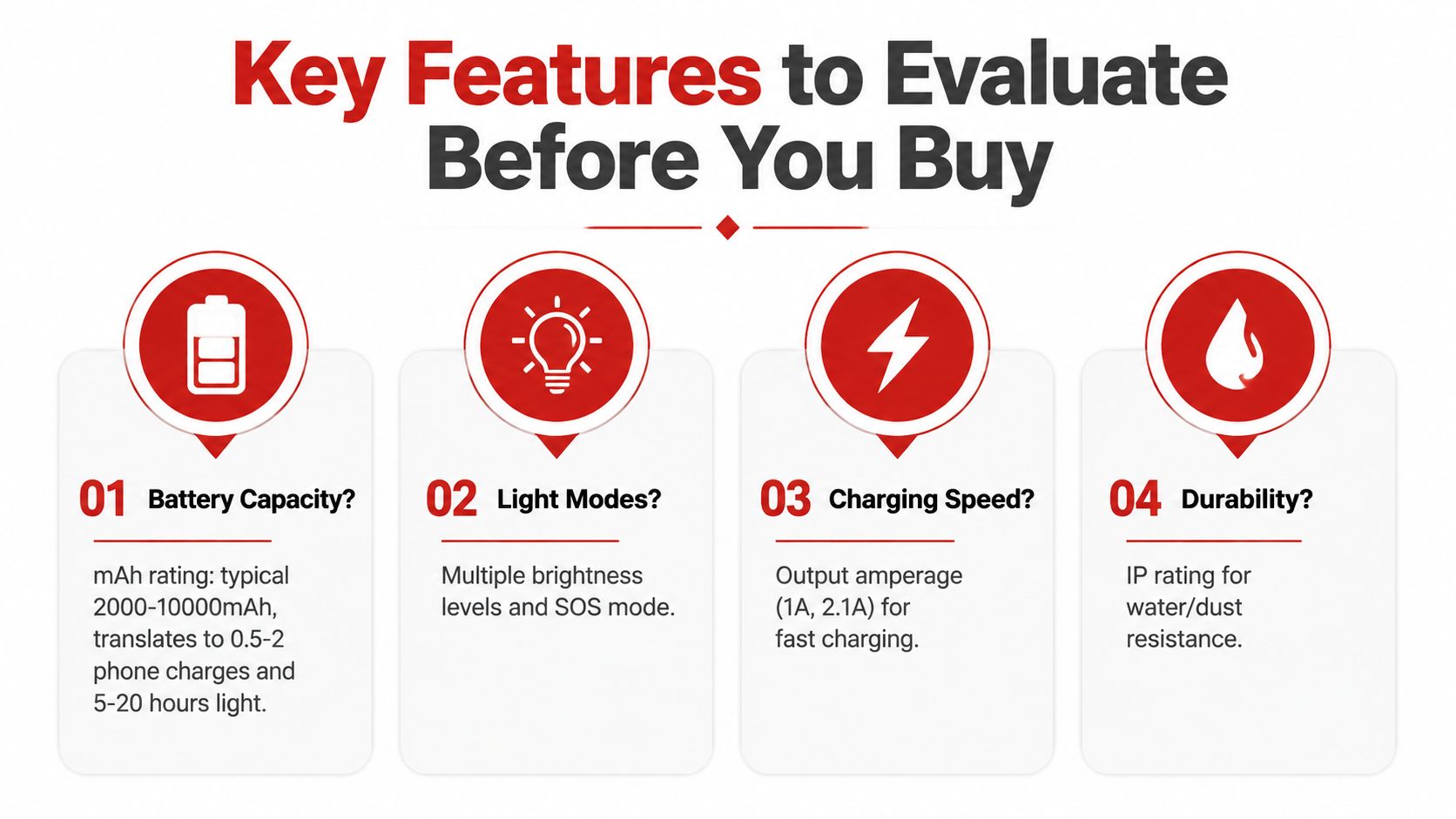
How much energy does the battery store
Look for a stated capacity in mAh or Wh. A larger battery can support longer lighting and a more useful phone top-up, but it usually adds weight and size. Capacity alone does not guarantee a specific number of phone charges. Energy is lost during voltage conversion, and phone batteries vary.
The infographic gives a typical range of 2,000 to 10,000 mAh, alongside an illustrative range of 0.5 to 2 phone charges and 5 to 20 hours of light. Treat these figures as orientation rather than a universal result. Electronics, brightness settings, and the phone itself can change the outcome.
How quickly can the lamp recharge
Check the USB input wattage, or its voltage-and-amp rating. A 5V/2A input provides a higher-power charging path than 5V/1A, provided the lamp's charging circuit can accept it. USB-C can be a practical choice, especially when the product clearly lists its USB-C input and output specifications. Buyers comparing solar lantern chargers and power banks should also consider how each tool handles stored energy, recharging, and phone support: comparing solar lantern chargers and power banks.
What can the output port do
A standard USB-A port works with many common phone cables. USB-C can reduce cable changes, while USB-C PD signals a higher-power charging design only when the product explicitly supports it. Check whether the lamp can charge a phone while illuminating. Some designs give priority to one function at a time, which changes their usefulness during an outage or overnight stop.
Does the light match the setting
Brightness modes usually tell you more than one maximum-lumen figure. A low setting can preserve energy inside a tent, while broad, warmer light may feel more comfortable on a patio. Look for runtime information at more than one brightness level.
Durability matters too. An IP rating describes resistance to dust or water under defined test conditions, but it does not automatically prove drop resistance. Look for impact-tested materials, protected ports, strong handles, and covers that stay closed during transport.
Weight and packed size determine whether the lamp enters the backpack at all. An outage kit may allow more bulk, while a backpacker may prefer a flat-folding body and hanging loop. For wider ambient-light planning during outages, event lighting ideas for load-shedding provide useful context beyond lanterns.
Real-World Uses for Camping, Outages, and Backyards
A phone charger lamp changes character depending on where it operates.
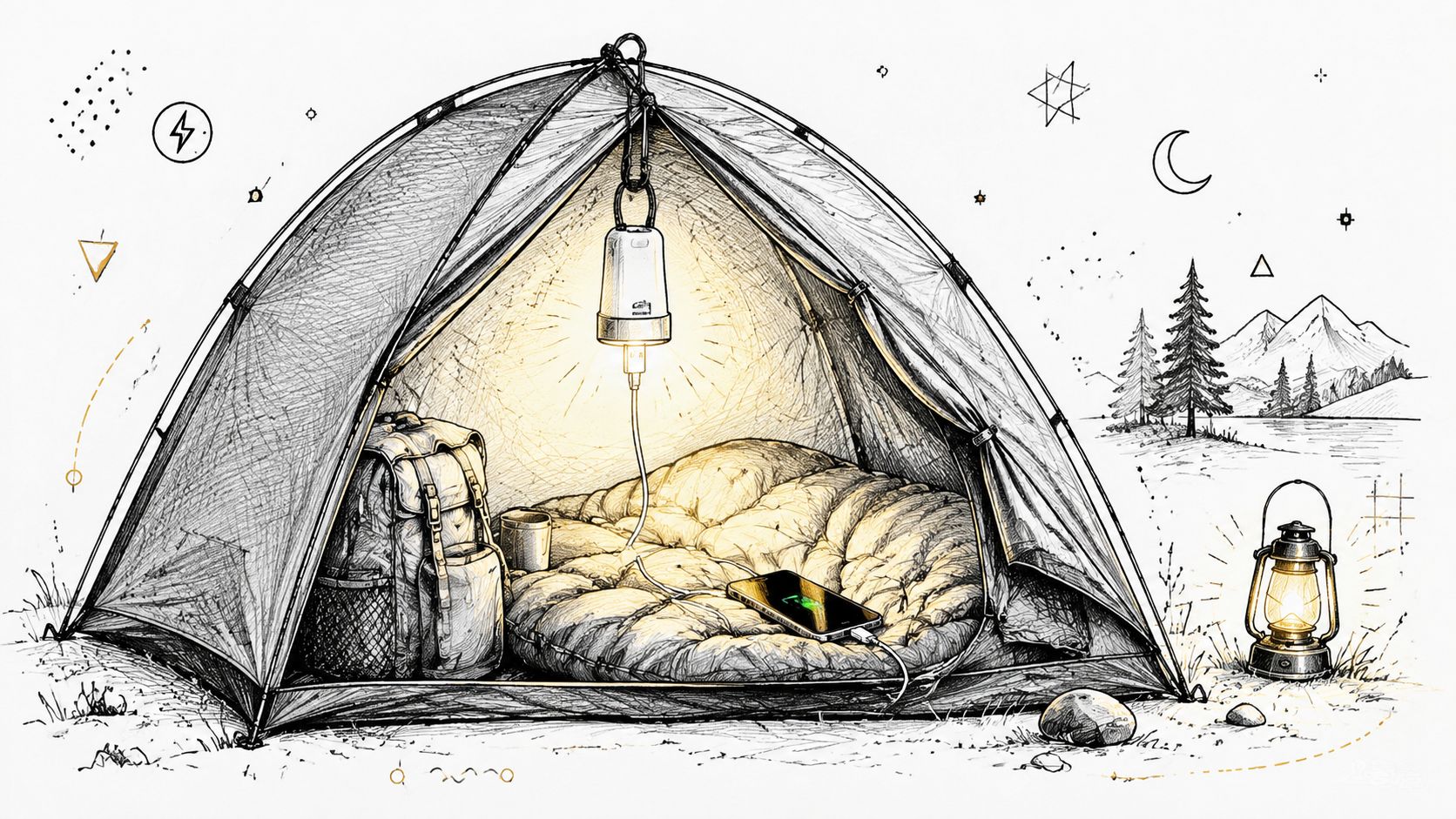
At camp, the lamp may hang from a tent loop after dark. Diffused light makes it easier to organize sleeping gear or prepare a meal without holding a flashlight between the teeth. Before sleep, a phone can connect to the USB output, but the camper should leave enough battery for morning navigation or weather checks.
In an outage kit, the priority shifts from low weight to readiness and reserve power. The lamp can recharge from a wall outlet between storms, then provide light when the grid fails. Medium brightness generally makes more sense than maximum output because it leaves energy for essential phone updates, calls, or alerts. The product should remain accessible in a go-bag rather than buried in a garage box.
On a patio, charging performance may matter less than light quality. A warm, diffused setting can provide comfortable table illumination for an evening without glare. A carry handle or hanging point lets the same unit move from a table to a porch hook or vehicle.
A useful comparison list such as this camping gear accessories guide can help buyers decide whether the lamp's weight and packed shape fit the rest of an outdoor kit.
The priorities are different in each setting:
- Camping: Weight, packability, hanging options, and solar maintenance charging matter most.
- Outages: Battery reserve, clear charge indicators, durable ports, and dependable USB input matter more.
- Backyards: Warmth, diffusion, stability, and appearance can outweigh maximum brightness.
Safety and Battery Care Essentials
Most integrated phone charger lamps use rechargeable lithium-ion or lithium-polymer cells. Australian product-safety guidance warns that these batteries can become highly flammable when incorrectly manufactured, handled, stored, or disposed of, and notes that incidents commonly happen while a phone or other device is charging. The guidance also says there is no mandatory safety standard for products containing these battery types in Australia, so the manufacturer's instructions deserve careful attention. Australian battery safety guidance covers charging, storage, damage, and disposal.
Safe charging habits
Charge the lamp on a non-flammable surface, away from direct sun and heat. Don't leave it inside a closed vehicle in direct sunlight. Use the supplied cable or a compatible certified cable, and stop using the unit if the battery swells, leaks, smells unusual, or shows physical damage.
A hard drop can damage cells or ports without leaving an obvious mark. Inspect the housing, charging socket, cable, and battery area before reconnecting power. A punctured or swollen lithium battery shouldn't be used or repaired casually because internal damage can lead to thermal runaway.
Storage and temperature
For a unit stored for months, a partial charge is generally more appropriate than leaving it fully depleted. A quarterly check and top-up gives an emergency lamp a better chance of being ready, while avoiding unnecessary heat exposure helps preserve capacity.
The supplied plan calls for avoiding charging in freezing conditions or above 113°F, or 45°C. Since product limits vary, the lamp's manual controls. A model without the relevant water-resistance rating shouldn't be submerged, even if its exterior looks sealed.
Storage rule: Emergency equipment only works when someone checks it. Keep the lamp accessible, inspect it periodically, and recharge it before the next season of severe weather.
Buying Checklist and How LuminAID Fits
A decision-ready checklist should focus on the battery and charging system first, then the light.
- Battery capacity: A capacity of at least 4,000 mAh is a useful starting point for a meaningful phone top-up, provided the lamp's conversion losses and phone size are considered.
- USB-C input wattage: A clearly stated input rating shows whether the lamp can recharge efficiently from a modern wall adapter or power station.
- Dual charging paths: Solar plus USB input gives maintenance charging outdoors and predictable preparation at home.
- Protection rating: An IP rating helps clarify exposure to rain, dust, or brief contact with water. The rating still needs to match the user's intended conditions.
- Weight and packed size: A compact, flat design has a better chance of entering a backpack, glove box, or emergency tote.
- Warranty and support: Clear warranty terms and accessible instructions matter when the lamp is stored for long periods and may be needed unexpectedly.
LuminAID's 2-in-1 lanterns provide a working example of this design approach. Their compact solar lanterns pair a built-in battery with USB and solar input, pack flat for travel, and carry an IP67 rating for rain and brief submersion. The company also operates Give Light programs that support disaster relief and communities without electricity, including work with partner organizations responding to emergencies.
That makes the brand useful as a case study in purpose-driven product design, not a substitute for checking specifications. A buyer should still confirm the exact model's battery capacity, USB input and output ratings, runtime, charging behavior, and warranty before purchase.
Common Questions About Phone Charger Lamps
How long does a fully charged lamp take to refill a phone
The answer depends on the lamp's output, stored energy, the phone's battery, and whether the LEDs remain on. A Panasonic solar LED lantern announcement gives a concrete example: a phone with a 700 mAh battery can be fully charged in about two hours, and a fully charged lantern can provide enough power for that phone once or twice. Panasonic's lantern announcement explains the phone-charging example.
A modern smartphone generally requires more stored energy than that example, so a lamp may provide a partial top-up rather than a complete refill. A 6,000 mAh lamp battery may deliver roughly one full smartphone charge in practical use, but the result varies with conversion efficiency and phone capacity.
Will solar work through a tent or window
Light can reach a panel through fabric or glass, but the panel receives less useful energy than it would in direct, unobstructed sunlight. A tent roof, tinted window, shade, cloud cover, and poor orientation can turn solar charging into a slow maintenance process. The lamp should be placed where the panel receives the strongest available daylight, without overheating the battery.
What happens when the lamp sits unused
Lithium batteries gradually lose charge in storage, and high heat can accelerate capacity loss. A partial-charge check every three to six months helps preserve readiness and gives the owner a chance to inspect the ports, housing, and cable. The exact storage percentage should follow the product manual, especially for long-term emergency storage.
Is it safe to leave the light on overnight
It can be reasonable when the lamp is placed on a stable, non-flammable surface and operated within its instructions. The main concern is not the clock, but heat, damaged batteries, blocked ventilation, and the remaining reserve needed for phone charging or the next night.
How can battery degradation be recognized
Shorter runtime, a battery that drains unusually quickly, failure to reach a full charge, excessive heat, or a USB port that stops working can indicate a problem. A swollen or damaged unit should be taken out of service rather than tested repeatedly.
LuminAID offers compact solar lanterns and 2-in-1 phone-charging lights for camping, outage preparation, and everyday outdoor use. Readers can compare the available charging paths, battery features, and packable designs by visiting LuminAID and choosing a model that matches their actual lighting and communication needs.