






Figuring out a battery's watt-hours is pretty simple: just multiply its voltage by its amp-hours (Watt-Hours = Volts × Amp-hours). This little formula is your key to getting a real, practical measure of a battery's total energy capacity. It tells you how long your gear will actually last.
Why Watt-Hours Are Your Best Guide to Battery Power
Ever wondered what separates a power bank that keeps you charged for days from one that dies unexpectedly? The answer is almost always watt-hours (Wh). It's the single best metric for a battery's true energy storage. While you’ll often see specs like milliamp-hours (mAh) advertised, they don't tell the whole story without also considering voltage.
Think of it this way: volts are like the water pressure in a hose, and amp-hours are how much water is in the tank. Watt-hours tell you the total amount of work that water can do.
That single number is what truly matters when you need to know how long your solar lantern will light up a tent or how many times your power bank can recharge a phone. Understanding this helps you pick the solar phone charger you need for power outages.
Getting a Handle on the Lingo
Before we jump into the math, let's get comfortable with the terms you'll see printed on batteries and power banks. Knowing what they mean is the first step toward figuring this stuff out for yourself.
Here's a quick reference to make sense of the core terms.
| Term | What It Measures | A Simple Analogy |
|---|---|---|
| Volts (V) | Electrical pressure or force. | How hard the electricity is "pushed." |
| Amp-Hours (Ah) | Electrical charge capacity over time. | How much "fuel" is in the tank. |
| Milliamp-Hours (mAh) | A smaller unit of amp-hours (1,000 mAh = 1 Ah). | A teaspoon vs. a gallon—same measurement, different scale. |
These terms might seem technical, but they're all you need to compare batteries like a pro.
Putting It All Together: A Real-World Example
The great thing is, you don’t need to be an electrical engineer to figure this out. The essential formula, Wh = Volts × Amp-hours, became the standard years ago, especially after U.S. regulations in 2011 mandated Wh ratings on lithium-ion batteries for air travel safety.
Let's walk through a common scenario. Say you have a battery for a portable device with these specs:
- Voltage: 11.1V
- Capacity: 4,400 mAh
First, you need to get everything into the right units. Since the formula uses amp-hours (Ah), we'll convert mAh to Ah by dividing by 1,000.
4,400 mAh / 1,000 = 4.4 Ah
Now, just plug the numbers into our formula:
11.1V × 4.4 Ah = 48.84 Wh
And there you have it! The battery holds 48.8 Wh of energy. This knowledge is vital when you're assembling an emergency kit and need gear you can count on from trusted brands like LuminAID and Survive Outdoors Longer.
The Core Formula for Calculating Watt Hours
Let's cut right to it. If you want to compare any two batteries on an even playing field, there’s one simple but powerful formula you need to know. This is the key to understanding your gear's true capacity.
The math is actually pretty straightforward:
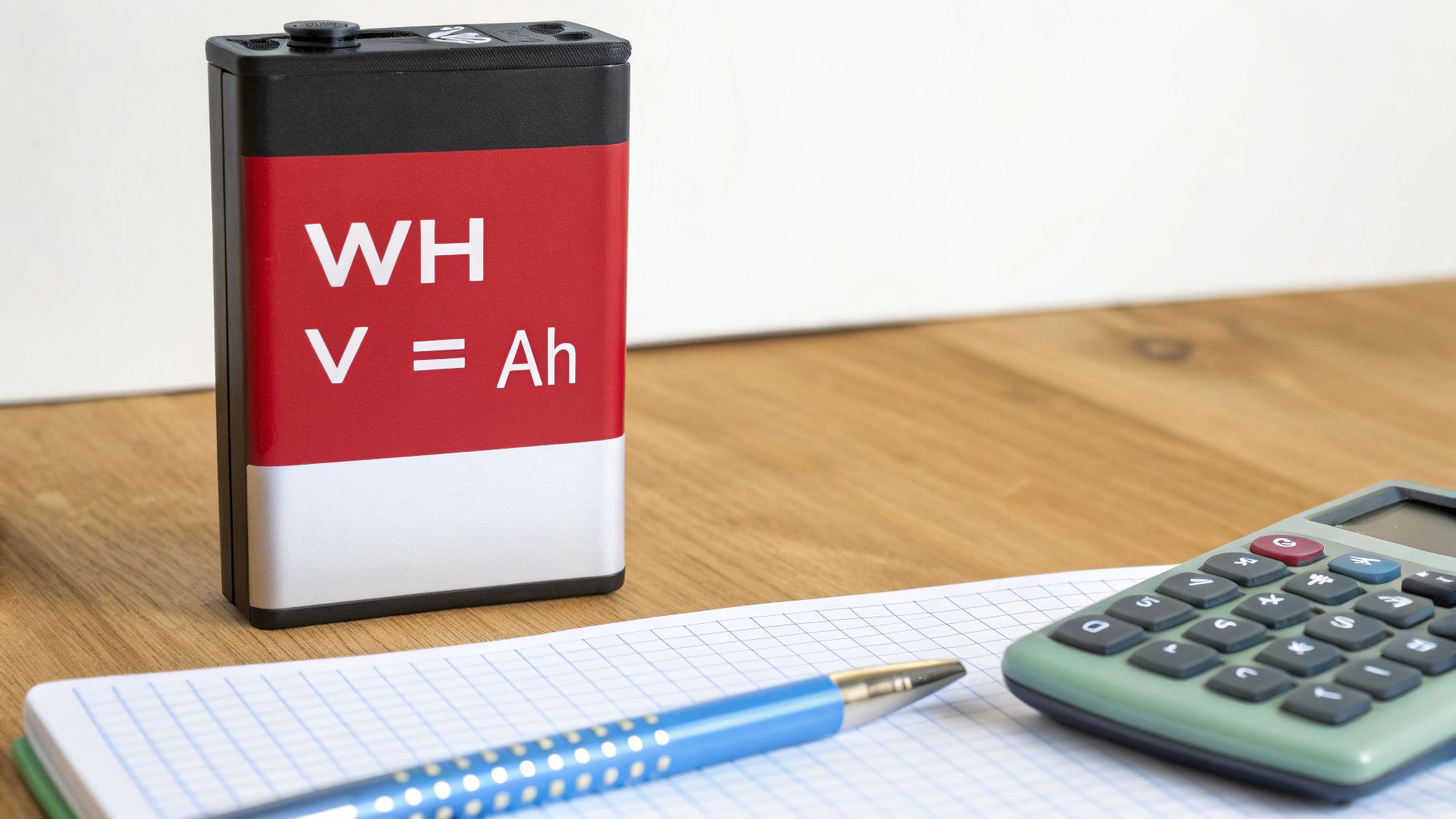
Watt-Hours (Wh) = Volts (V) × Amp-Hours (Ah)
Think of this formula as the universal translator for battery energy. It lets you figure out exactly how much total energy is stored in your power banks, solar lanterns, or any other portable power source. It's a game-changer, especially if you're putting together an emergency kit where reliable power is non-negotiable.
Finding the Numbers on Your Battery
To get started, you'll need two key values: voltage (V) and amp-hours (Ah). Most of the time, manufacturers print this information right on the battery's label, its casing, or somewhere in the user manual. Just look for a number followed by a "V" for volts and "Ah" for amp-hours.
You might run into a common snag, though. Many smaller devices, like power banks and smartphones, list their capacity in milliamp-hours (mAh) instead. Don't let that throw you off—the conversion couldn't be easier.
Since there are 1,000 milliamps in one amp, you just divide the mAh number by 1,000.
Amp-Hours (Ah) = Milliamp-Hours (mAh) / 1,000
So, that 20,000 mAh power bank you have is actually 20 Ah (20,000 / 1,000 = 20). Once you've done that quick bit of math, you're all set to find the watt-hours.
Real-World Calculation Examples
Let's put this into practice with gear you probably own. Knowing how to calculate a battery's watt-hours helps you make smarter choices, whether you’re buying a new solar lantern or just seeing what your current setup can handle.
Example 1: A Standard Power Bank
- Capacity: 10,000 mAh
- Voltage: 3.7V (this is a very common voltage for the lithium-ion cells inside power banks)
First, we need to convert mAh to Ah:
- 10,000 mAh / 1,000 = 10 Ah
Now, just plug it into the main formula:
- 3.7V × 10 Ah = 37 Wh
That power bank holds 37 watt-hours of energy. That’s a real, tangible number you can use to estimate how many times you can actually charge your phone.
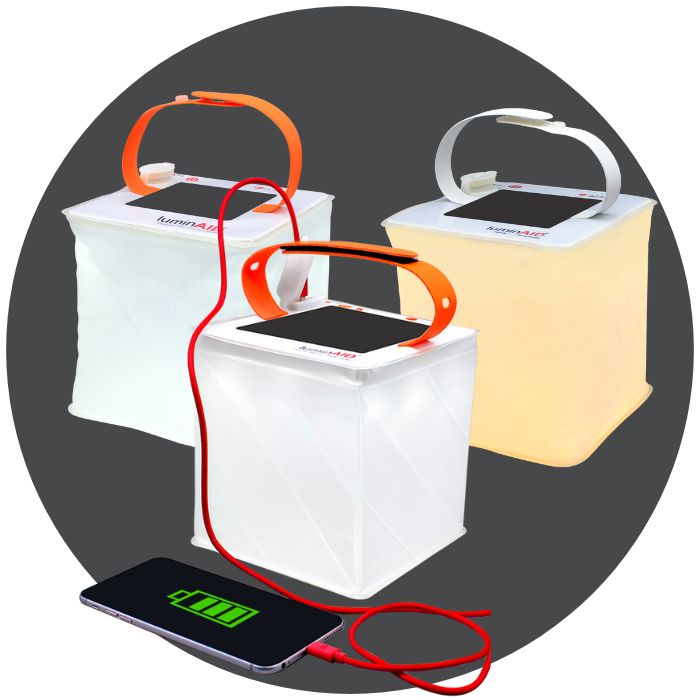
Example 2: LuminAID Titan 2-in-1 Power Lantern
- Capacity: 4,000 mAh
- Voltage: 3.7V
Same deal. First, convert the capacity:
- 4,000 mAh / 1,000 = 4 Ah
Then, do the final calculation:
- 3.7V × 4 Ah = 14.8 Wh
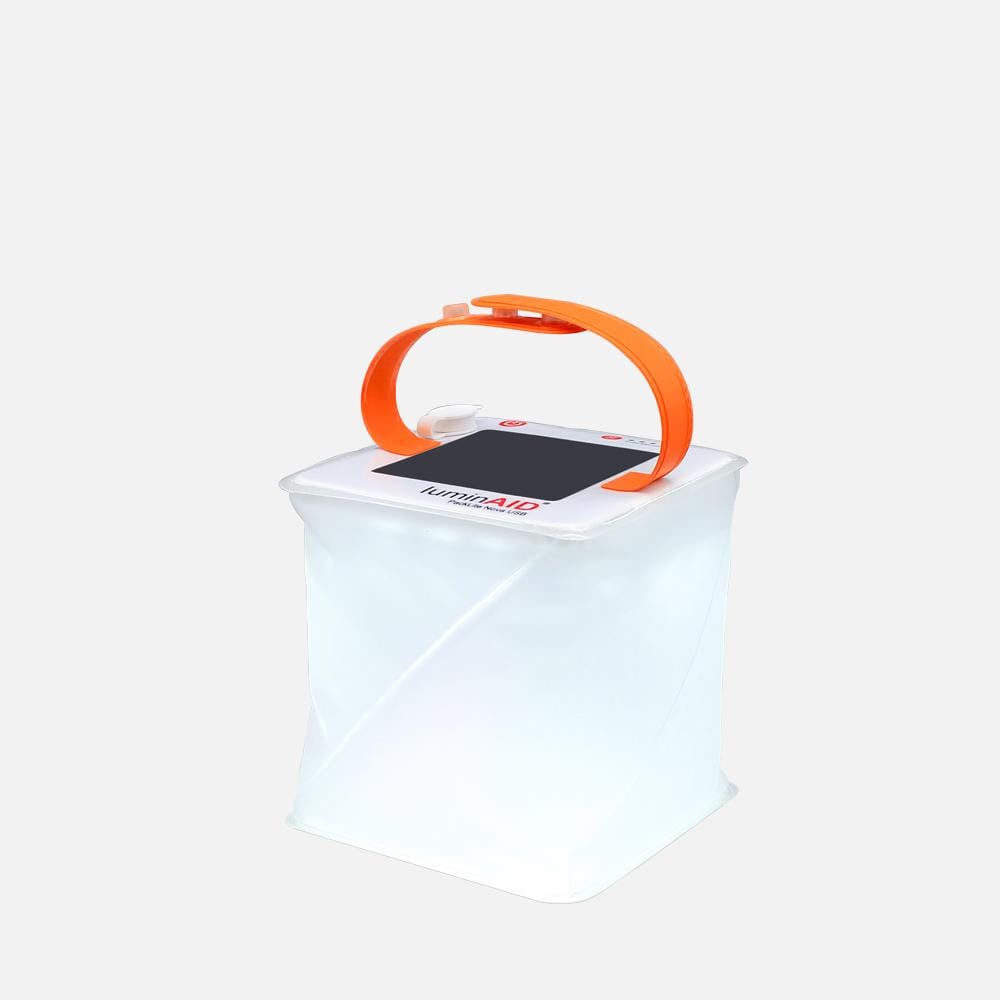
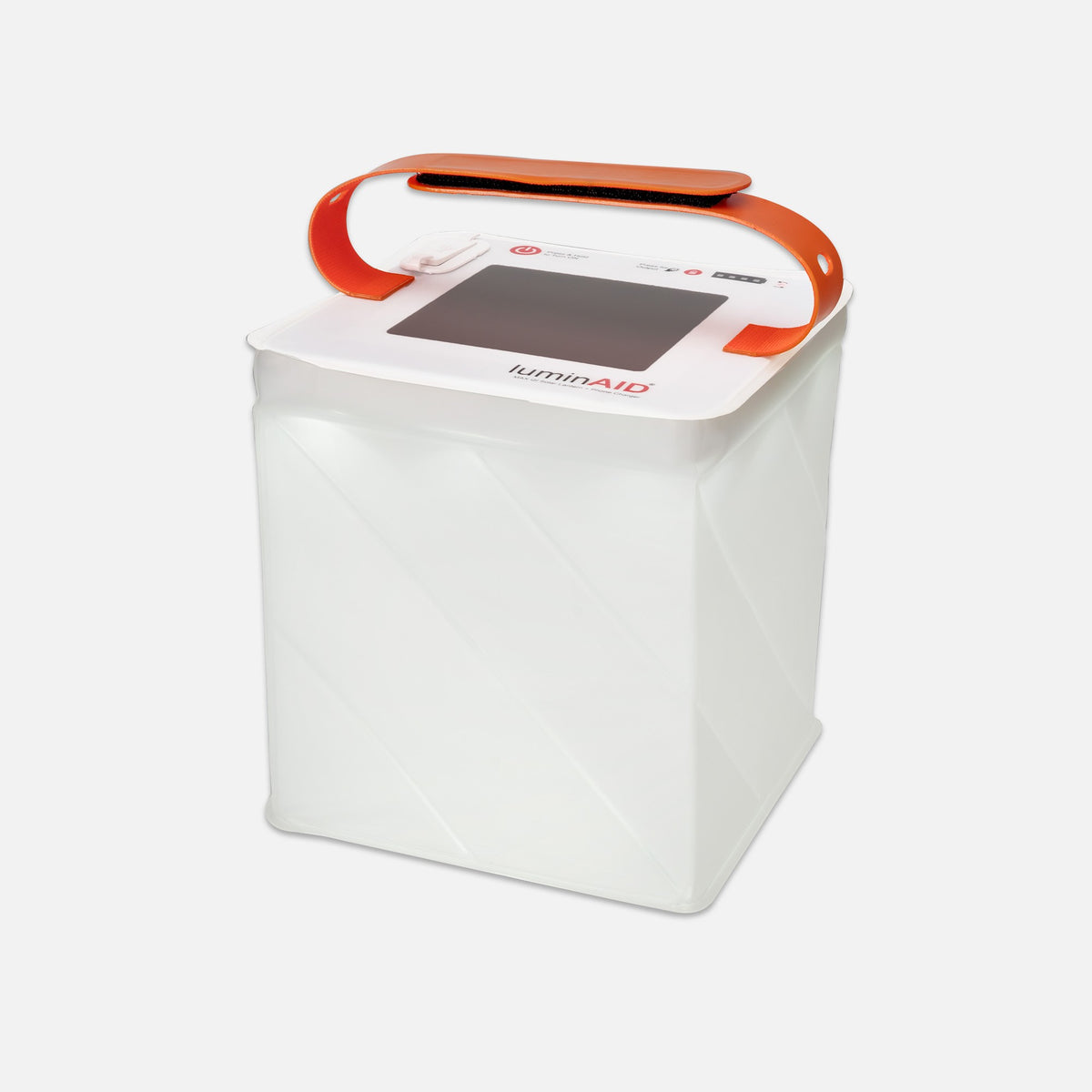
The Titan has 14.8 watt-hours of juice, which is enough to provide light for over 100 hours on its low setting or give your phone a critical power boost. For gear like this, knowing how a bigger solar panel impacts charging can help you keep it topped off in the field.
Understanding this is more important than ever. With major power outages affecting 1.2 million U.S. households in 2024 alone, having a reliable backup is crucial. For comparison, a standard 12V, 100 Ah deep-cycle battery gives you 1,200 Wh of energy—plenty to run essential devices for a good while. This kind of knowledge is what real emergency preparedness is all about.
How to Estimate Real-World Device Runtimes

Alright, you've got your battery's watt-hours figured out. That’s a great start, but the real magic is turning that number into a practical estimate of how long your gear will actually last. This is where you go from theory to real-world planning—whether you're packing for a weekend off-grid or prepping for an emergency.
At its core, the estimation is pretty straightforward. You're just comparing your battery's energy reserve to your device's power needs.
Estimated Runtime (in hours) = Battery Watt-Hours (Wh) / Device Power Consumption (in Watts)
This simple calculation bridges the gap between the specs on your battery and the performance you can actually count on. It's how you answer crucial questions like, "How many nights can this lantern really light up my tent?"
Finding Your Device’s Power Consumption
To make this work, you first need to know how much juice your device is pulling. This is measured in watts (W), which is just the rate of energy use. Think of it as how quickly your gadget "drinks" from the battery's tank.
You can usually hunt this information down in a few places:
- On the device's AC adapter: Look for the "Output" section. You might see volts and amps listed separately (like 5V, 2A). If so, just multiply them together to get watts: 5V × 2A = 10W.
- On the device itself: Check the back or bottom for a label with all the technical specs.
- In the user manual or online: A quick search for your device's model number plus "power consumption" or "watts" usually gets you what you need.
Once you have the wattage, you’re ready to see how your battery stacks up.
Putting It All into Practice
Let's walk through a couple of common scenarios to see how this plays out. I’m using realistic numbers here to give you a clear picture of what to expect from your gear.
Example 1: Charging an iPhone 15 with a Power Bank
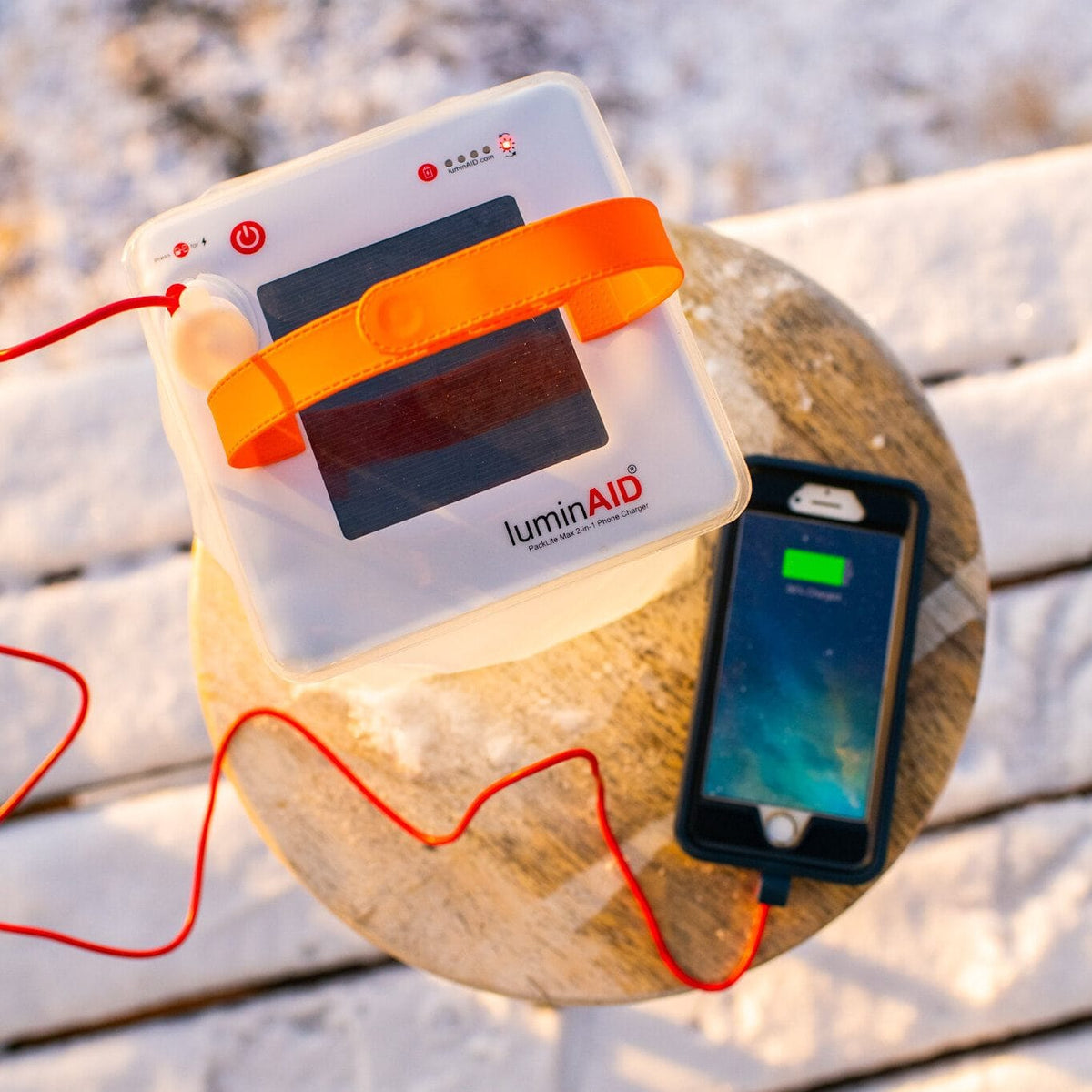
Say you have a 37 Wh power bank (a pretty standard 10,000 mAh model). You want to know how many times you can charge your iPhone 15, which has an approximately 12.7 Wh battery.
- Calculation: 37 Wh (Power Bank) / 12.7 Wh (iPhone) = 2.9 charges
In an ideal world, you'd get almost three full charges. This kind of planning is critical for any adventure, making sure you have reliable communication and navigation when it counts. It's the same reason we believe keeping a solid first aid kit, like the ones from Adventure Medical Kits, is just as important as having power.
Example 2: Powering a LuminAID Lantern
Now let's imagine you're using a LuminAID lantern with a 14.8 Wh battery to light up your campsite. The lantern has a few brightness settings, and you want to use a mode that draws 1 watt of power.
- Calculation: 14.8 Wh (Lantern Battery) / 1 W (Light's Consumption) = 14.8 hours
You can expect nearly 15 hours of continuous light on that setting. This simple math helps you manage your light through the night without worrying it'll die on you. Knowing these runtimes is the key to packing smarter and staying safer in the outdoors, which also means having gear like reliable water filters from brands such as RapidPure.
Why Your Battery Life Is Never What the Box Says
You’ve done the math, figured out the watt-hours, and have a runtime estimate in your head. So why does your gear always seem to die faster than you expect? It’s a frustratingly common experience.
The truth is, the watt-hour rating on a battery represents its ideal capacity, measured under perfect lab conditions. Out in the real world, a handful of factors start chipping away at that number. This gap between the advertised capacity and what you actually get isn't a marketing trick; it's just physics.
Understanding these real-world variables is the final piece of the puzzle to accurately predict how long your batteries will really last when you need them most.
The Inefficiency Factor
One of the biggest culprits is efficiency loss. When you use a power bank to charge your phone, you're transferring energy from one battery to another, and that process is never perfect. Some of that energy is always lost as heat.
Think of it like pouring water from one bucket into another—you’re bound to spill a few drops. The same thing happens with electricity. Most power banks operate with around 80-90% efficiency.
A good rule of thumb is to multiply your battery’s watt-hours by 0.85 to get a more realistic idea of its usable energy. So, for a 50 Wh power bank, you should only expect to get about 42.5 Wh of actual charging power out of it.
Understanding Depth of Discharge
Another key concept to get your head around is Depth of Discharge (DoD). This is just a fancy term for how much of a battery's capacity you use before plugging it back in. While you can drain most modern lithium-ion batteries down to zero, it's terrible for their long-term health.
Frequently running a battery completely flat puts a ton of stress on its internal chemistry. It’s like sprinting a marathon every day—you’ll wear it out much faster. This is why learning how to boost your electric bike battery life involves smart charging habits, not just riding style.
- Best Practice: Try to avoid letting your devices regularly drop below 20% charge.
- The Payoff: Sticking to this habit can dramatically extend the total number of charge cycles your battery can handle over its lifespan.
For anyone who relies on batteries for more than just their phone—think RVers or off-grid campers—this stuff is non-negotiable. Knowing that your 12V, 50 Ah battery setup provides 600 Wh is step one. Step two is realizing you should only plan on using about 480 Wh of that to keep the battery healthy.
To put this in perspective, here's a quick cheat sheet for what you can actually expect to run from a typical 50 Wh power bank, factoring in that 85% efficiency loss.
Runtime Reality Check Cheat Sheet
| Device | Typical Power Draw (Watts) | Ideal Runtime (Hours) | Realistic Runtime (at 85% efficiency) |
|---|---|---|---|
| Smartphone (charging) | 10 W | 5.0 | 4.25 |
| Tablet (charging) | 18 W | 2.8 | 2.36 |
| LED Camping Lantern | 5 W | 10.0 | 8.5 |
| Small Drone Battery (charging) | 40 W | 1.25 | 1.06 |
As you can see, that 15% loss adds up and can mean the difference between having a charged phone or a dead one.
Temperature Extremes and Battery Drain
Finally, never underestimate the impact of temperature. Batteries are a bit like people—they don't like being too hot or too cold.
Extreme cold slows down the chemical reactions inside a battery, which temporarily tanks its capacity. You've probably seen this happen when your phone dies unexpectedly on a cold winter day. On the flip side, high heat can permanently degrade a battery's health, shortening its overall lifespan for good.
A simple tip for cold weather is to keep your power bank and phone in an insulated pouch or an inside pocket close to your body. It’s a small trick that can make a huge difference in preserving their charge when you’re counting on them.
Finding Battery Specs When They Are Not Listed
Ever picked up a battery, maybe an older one or a generic power bank, and found it completely blank? No voltage, no amp-hours, nothing. It’s a frustrating moment when you’re trying to figure out its capacity, but you’re not out of luck. Time to do a little detective work.
Your first move should be to hunt for a model number. Even unbranded gear often has a small string of characters printed or etched somewhere on the casing. A quick online search for that model number can be surprisingly effective, often leading you straight to a manufacturer's spec sheet or a product listing with the original details.
Using Tools for a Hands-On Approach
If the internet comes up empty, it’s time to get a bit more hands-on. For any device that charges with a USB cable, one of the most useful tools you can own is an inexpensive USB power meter.
These little gadgets plug in between your charger and your device, measuring the actual flow of energy.
By completely draining the battery and then recharging it through the meter, you can get a surprisingly accurate reading of its true capacity. The meter will tell you the total milliamp-hours (mAh) it delivered to the battery. Honestly, this is often more reliable than the printed specs anyway, since it reflects the battery's current health, not just its factory rating. If you can’t find the manufacturer's numbers, you might have to figure them out yourself by learning how to test battery capacity.
This real-world measurement is invaluable. It gives you a practical number to use for your watt-hour calculations, reflecting the battery's age and wear, not just what it was rated for on the day it was made.
The Value of Clear Labeling
This whole process really shines a light on why it’s so important to choose gear from transparent brands. When a company clearly labels its products with accurate voltage and capacity ratings, it shows a commitment to its customers and the reliability of its gear. It saves you the headache of hunting down information or buying extra tools.
Knowing the exact specs is the foundation for properly using your equipment. You can see this in practice by reading our guide on how to charge your LuminAID to get the most out of every cycle. Reliable specs mean you can accurately calculate watt-hours and, in turn, trust your gear will perform exactly when you need it most.
Common Questions About Battery Capacity and Runtimes
After digging into the formulas and real-world factors, some common questions always seem to pop up. We've gathered the most frequent ones to give you quick, clear answers that build on everything you've just learned.
Think of this as your go-to reference for those nagging "why does my battery do that?" moments. It'll help you solve those frustrating battery mysteries and get confident with your portable power.
Why Does My Power Bank Seem to Underperform?
It’s one of the most common frustrations out there: why can't my 10,000 mAh power bank fully charge my 4,000 mAh phone three times? The math seems simple, but the answer lies in a mix of voltage differences and efficiency loss.
The cells inside your power bank are usually 3.7V, but they have to output power at 5V through the USB port. This voltage conversion process isn't perfect; some energy is always lost as heat. That unavoidable inefficiency, plus the energy your phone uses while it's charging, is why you get fewer charges than you'd expect.
The key takeaway is that milliamp-hours (mAh) don't tell the whole story without voltage and efficiency. Watt-hours (Wh) give you a much more accurate picture of a battery's true, usable energy.
Watt-Hours Versus Milliamp-Hours
So what's the real difference? Think of it like this: milliamp-hours (mAh) are like the size of a car's fuel tank, while watt-hours (Wh) tell you how far that car can actually drive.
- mAh measures charge capacity.
- Wh measures the total energy stored.
Because batteries operate at different voltages, Wh is the universal standard for comparing the true energy between two different power sources. It levels the playing field, making it the most reliable metric when you want to calculate how long a battery will actually last.
Airline Restrictions and Watt-Hours
Understanding watt-hours is especially critical when you travel. Most airlines and transportation authorities, including the TSA, restrict spare lithium-ion batteries to 100 Wh in your carry-on luggage. Anything larger often requires special airline approval.
This is a huge reason why knowing how to calculate your battery's watt-hours is so important. A quick calculation confirms that most portable chargers and solar lanterns, including all LuminAID products, fall safely under this limit. This knowledge ensures you won't face any surprises at airport security, making your travel that much smoother. It's just as smart as packing essentials like a good insect repellent from a brand like Natrapel.
For all your off-grid lighting and charging needs, from backyard adventures to emergency kits, LuminAID provides reliable, solar-powered solutions that are built to last. Explore our collection of innovative solar lanterns and 2-in-1 phone chargers at https://luminaid.com.