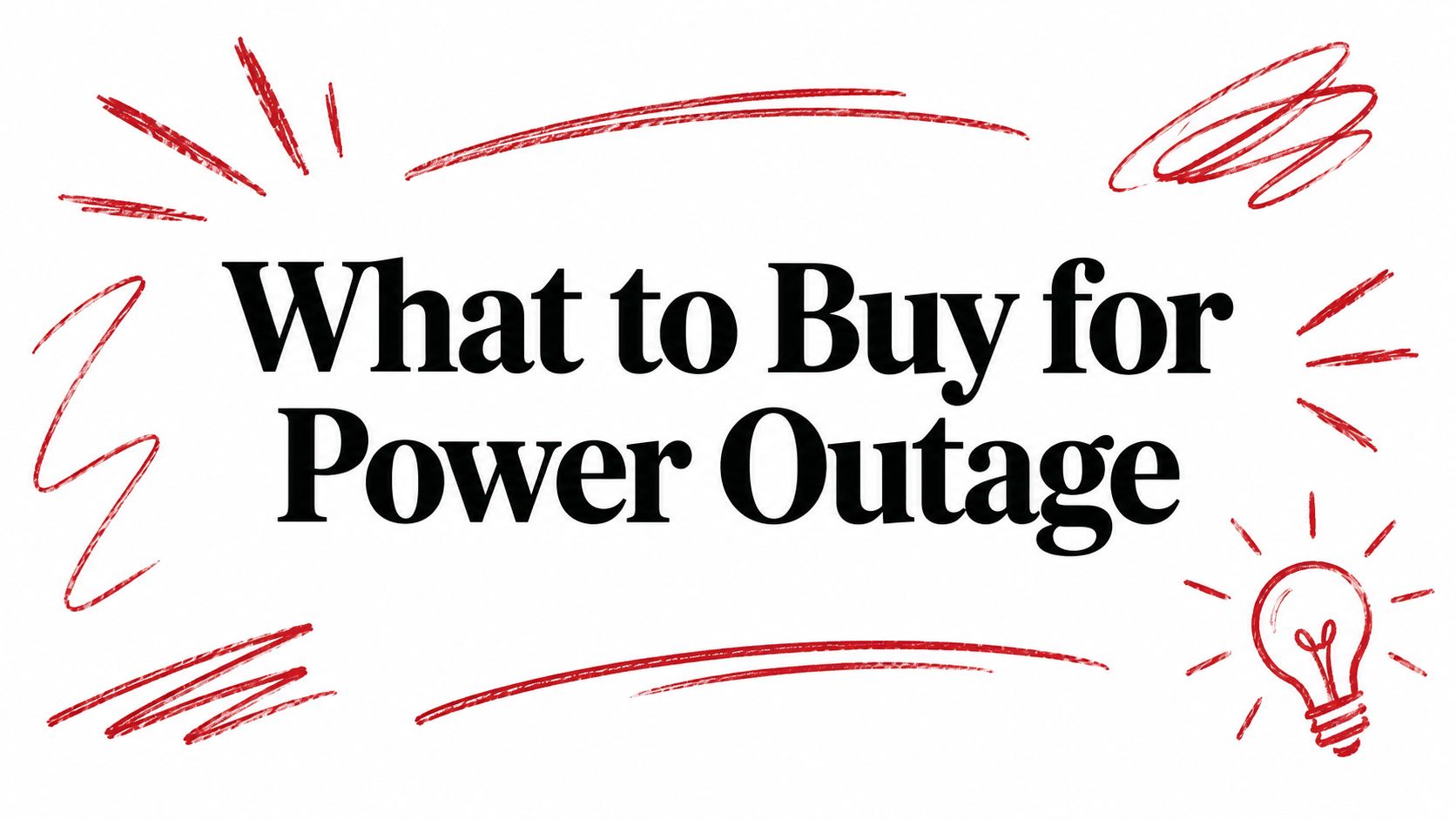



A storm has knocked out the power, dusk is settling over the campsite, and a lantern that seemed simple in the daytime suddenly becomes essential. The useful question isn't only whether the light turns on. It's how solar lantern works under cloudy weather, repeated use, aging batteries, and changing brightness settings.
A solar lantern is a compact off-grid system. Its photovoltaic panel collects sunlight, its rechargeable battery stores electrical energy, and its LEDs use that stored energy after dark. Understanding the complete path helps campers, families, and emergency planners choose better equipment and troubleshoot it more confidently.
Table of Contents
- The Complete Journey from Sunlight to Illumination
- How the Solar Panel Captures and Converts Sunlight
- Battery Storage and Charge Control Electronics
- LED Light Output and Automatic Dusk to Dawn Switching
- Real World Runtime and Performance Variables
- Maintenance Tips and Troubleshooting Common Issues
- Choosing the Right Solar Lantern for Your Needs
The Complete Journey from Sunlight to Illumination
At a campsite, the process begins before anyone needs light. The lantern sits with its solar module facing open sky while sunlight reaches the photovoltaic cells. Those cells convert sunlight into direct-current electricity, and the charging circuit sends that energy into the internal rechargeable battery.
After sunset, the panel no longer supplies useful charging power. In many designs, the panel is disconnected at night, so the lantern operates as an independent portable light source, as described in this solar-lantern user manual. A control circuit then draws energy from the battery and delivers it to the LED module.
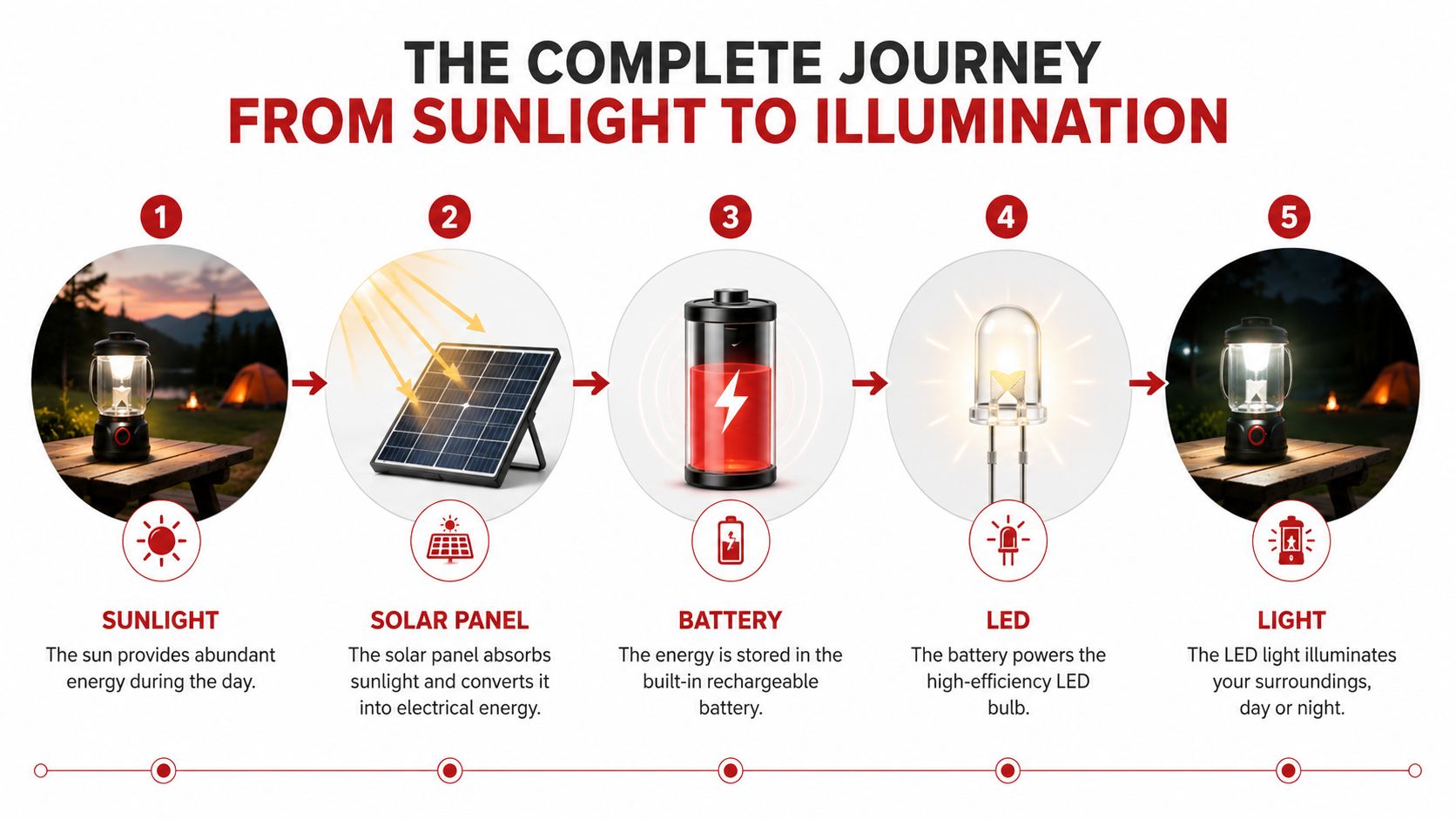
A useful analogy is a water bucket. During the day, the panel fills the bucket with electrical energy. At night, the LEDs pour that stored energy out as light. A larger panel can collect energy more quickly, a larger battery can hold more of it, and a brighter LED setting empties the reserve faster.
The five parts in the energy path
- Solar module: Photovoltaic cells capture sunlight and generate DC electricity.
- Charge controller: Electronics regulate the flow into the battery and help prevent damaging charging conditions.
- Rechargeable battery: The battery stores energy for use after sunset.
- LED driver and LEDs: The driver manages electrical current, while the LEDs convert electricity into visible light.
- Switching and protection circuits: These control operation, prevent reverse current, and may detect dusk and dawn.
That architecture explains why solar lanterns work without disposable batteries or grid power. It also explains why the lantern's parts can't be judged separately. A strong LED won't compensate for a poorly charged battery, and a large battery won't help much if the panel receives shade.
Portable lights have become an important part of off-grid lighting. GOGLA reported 2.81 million solar lanterns sold globally in the second half of 2019, while 2.5 million sold in the second half of 2021, when lanterns represented 63% of all off-grid solar product sales (GOGLA market report). For a deeper introduction to portable solar lighting, this guide to portable solar power lights provides useful context.
How the Solar Panel Captures and Converts Sunlight
The panel is the lantern's energy collector. Inside its protective surface are solar cells made from photovoltaic material. When sunlight reaches those cells, photons transfer energy to the material, causing electrical charges to move and creating a flow of direct-current electricity.
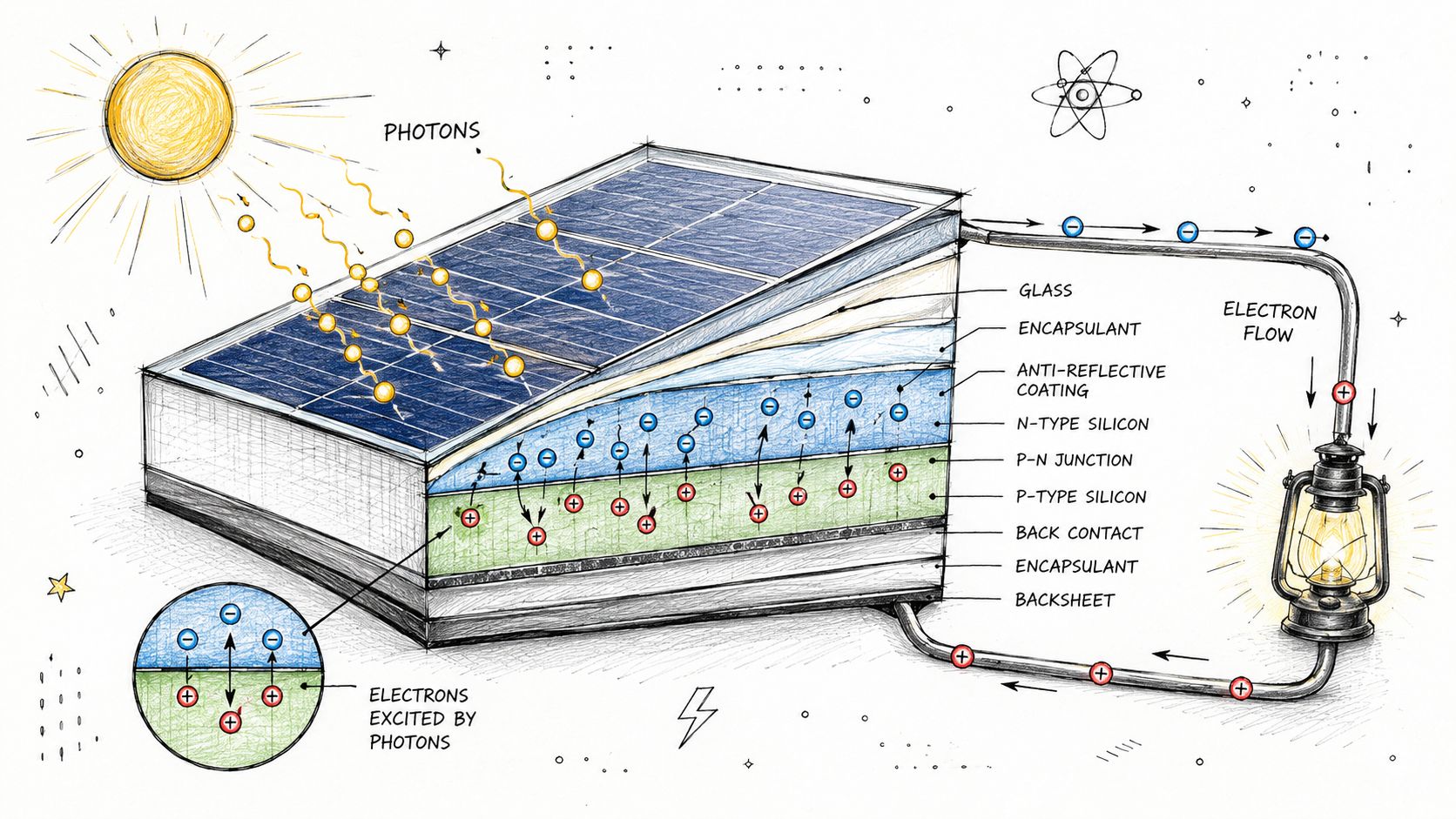
The process resembles a group of tiny energy catchers. Each cell collects part of the incoming light, and the cells work together to provide the voltage and current needed by the charging system. The panel doesn't produce light for the LEDs directly at night. It produces electricity during daylight, then the battery supplies the LEDs later.
What panel ratings mean
A common practical circuit uses a 6V/1W solar panel with a 4V/800mAh rechargeable battery. In middling sunlight, that panel can produce around 170mA at 6V, enough in the example circuit to charge the battery and operate the LEDs through a control system that limits reverse current and overcharging (EDN technical example).
Wattage describes the panel's electrical output under specified conditions. A higher-wattage panel can generally provide more charging power, but the battery and controller must be compatible with it. Panel size also affects how much sunlight the lantern can collect, although placement remains just as important as the rating.
Why placement changes charging
A panel under leaves, behind a tent wall, or tilted away from the strongest available sunlight collects less energy. A clear day gives the cells more usable light than a cloudy afternoon, and seasonal sun angles can alter how much energy reaches the panel.
The practical routine is simple:
- Expose the panel: Place it where nearby branches, walls, and gear won't cast shadows.
- Aim toward the sun: Adjust the angle when the lantern's design allows it.
- Keep the surface clear: Dust, pollen, and debris reduce the light reaching the cells.
- Separate charging from convenience: A shaded spot that's convenient at camp may be a poor charging location.
For readers planning a broader outdoor setup, these design backyard illumination ideas offer useful context on placement and light distribution. The same principle applies to a lantern. Light collection comes before runtime.
Battery Storage and Charge Control Electronics
The battery determines how much energy remains available after sunset. The charge controller sits between the panel and battery, regulating charging and helping protect the battery from excessive voltage, reverse current, and unsuitable discharge.
Government specifications for white-LED solar lantern systems commonly allow sealed lead-acid, NiMH, or lithium-ion batteries, set maximum depth of discharge around 75%, and target total electronic efficiency between 72% and 85% (government technical specifications). Depth of discharge describes how much of the stored capacity the system uses before recharging. Repeatedly draining a battery beyond its intended limit can shorten its useful life.
Chemistry changes the ownership experience
Battery chemistry affects weight, usable capacity, safety characteristics, charging behavior, and replacement needs. Lithium-ion is compact and energy-dense, while lithium-iron-phosphate is modeled to provide longer service in lantern applications than lithium-ion and sealed lead-acid. NiMH avoids some of the concerns associated with older rechargeable designs, while sealed lead-acid is durable but heavier.
The comparison below summarizes the main trade-offs without treating one chemistry as suitable for every lantern.
| Battery Type | Typical Lifespan | Weight | Key Advantage |
|---|---|---|---|
| Lithium-ion | Shorter than the panel and LED, replacement depends on use and protection | Light | Compact energy storage |
| Lithium-iron-phosphate | Modeled to outlast lithium-ion and sealed lead-acid in lantern use | Light to moderate | Long service potential and stable operation |
| NiMH | Depends on charging and discharge practices | Moderate | Familiar rechargeable chemistry |
| Sealed lead-acid | Often limited by aging and repeated cycling | Heavy | Established, durable battery format |
Battery aging is the component issue many basic explainers overlook. One lifecycle model estimates that LEDs can last about 17 years, solar panels about 30 years, and batteries may need replacement roughly every 3 years (World Bank technical document). Those figures describe modeled component life, not a guarantee for every product.
Practical rule: A lantern's panel and LEDs may remain functional while its battery gradually loses capacity. Reduced runtime doesn't automatically mean the entire lantern has failed.
The controller matters because the battery needs controlled treatment. Poorly matched charging set-points can shorten battery life, and inadequate protection can reduce reliability. A battery-capacity guide using watt-hours can help users interpret storage specifications without confusing voltage, amp-hours, and actual available energy.
LED Light Output and Automatic Dusk to Dawn Switching
LEDs are well suited to solar lanterns because they produce useful illumination from a relatively small electrical load, create little waste heat compared with older lamp technologies, and contain no fragile filament. Their solid-state construction also suits equipment that gets packed, carried, and used outdoors.
The LED doesn't normally connect straight to the battery. A driver circuit regulates current so the light operates within its intended electrical range. On a lantern with multiple brightness settings, the control system changes the power delivered to the LED. Lower brightness uses less stored energy and can extend usable operation, while higher brightness produces more illumination but draws energy faster.
Why brightness changes during discharge
Battery voltage falls as stored energy is used. Technical guidance for portable photovoltaic lanterns notes that LED output can decline as battery voltage drops, which means illumination isn't necessarily constant throughout the discharge cycle (Lawrence Berkeley National Laboratory guidance).
A well-designed driver can manage that decline rather than allowing abrupt, unstable behavior. Even so, the battery's state still affects the light. A lantern that looks bright soon after charging may appear softer later in the night, especially when operated at a high setting.
How automatic switching detects darkness
Many solar lanterns use the panel as a light sensor. During daylight, panel output signals that the environment is bright, so the lantern keeps the LEDs off. As sunlight fades, panel output drops enough for the control circuit to interpret the change as dusk, and the light turns on. At sunrise, panel generation rises again, causing the system to switch the LEDs off and resume charging, as explained in this stand-alone LED lighting study.
This arrangement removes the need to find a small button in the dark. It can also create confusion if a nearby porch lamp or flashlight shines on the panel, because the lantern may interpret that light as daytime.
Real World Runtime and Performance Variables
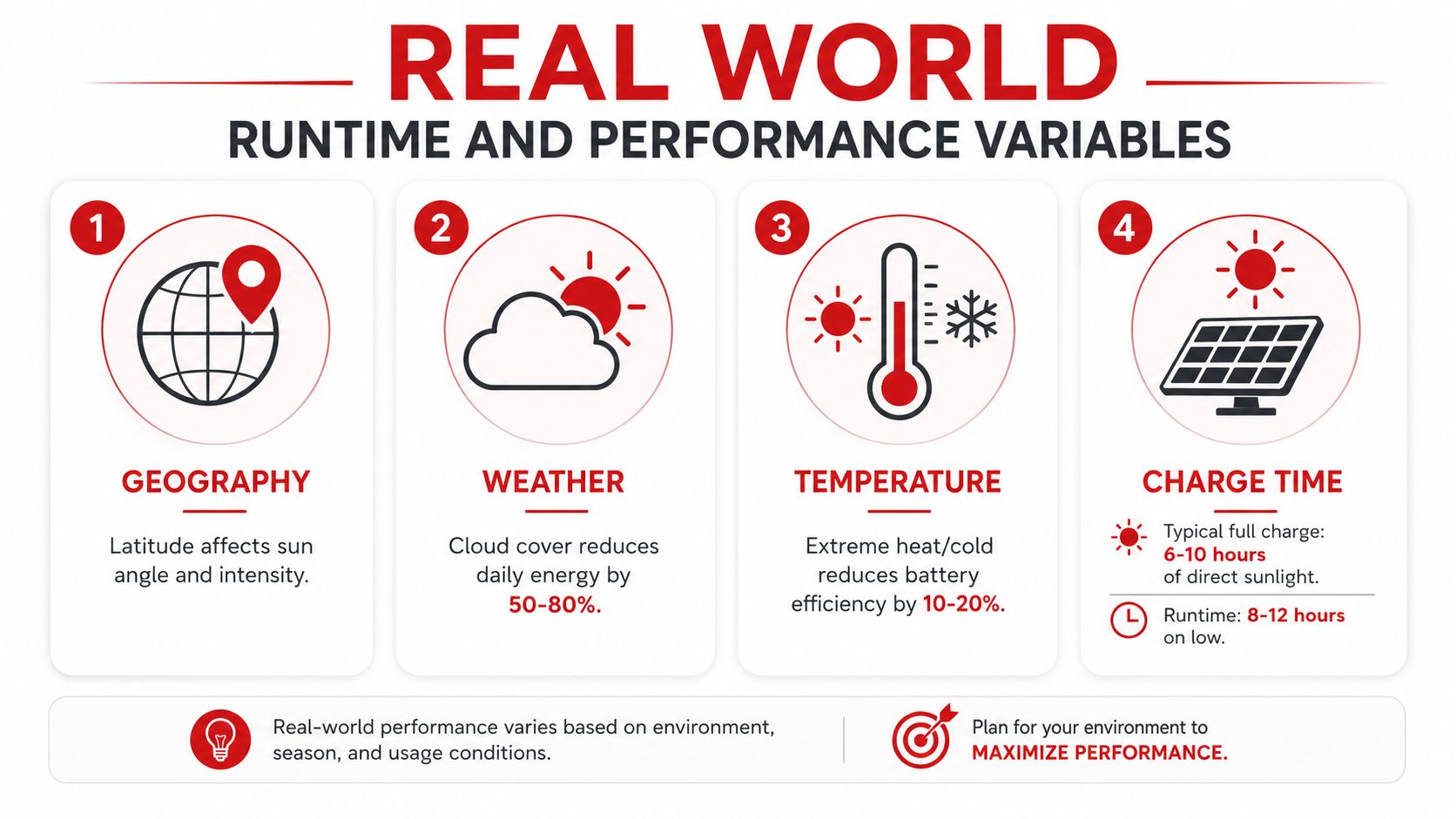
“Charge by day, light by night” describes the system, but it doesn't promise identical performance every night. Geography, weather, season, panel angle, battery condition, and brightness setting all change the energy balance.
A lantern in open sunlight has a better opportunity to recharge than one placed under a shelter. Cloud cover reduces available light, and seasonal changes alter the duration and angle of sunlight. Product manuals and test literature also emphasize that illumination duration depends on geography, weather, and seasonal light availability (product test documentation).
The brightness and runtime trade-off
Brightness is a power decision. Increasing LED output increases current draw, so the battery reserve falls faster unless the system also has more stored energy and enough solar input to replenish it.
A measured example illustrates the relationship. One system using a 12V, 7.2Ah battery and a 12W solar panel required about 9 hours to charge and delivered about 10 hours of backup with a 5W LED load, while maintaining 169.4 lux at 1 foot for reading (white-LED solar lantern specifications). That result applies to the tested setup, not every portable lantern.
A lantern's output can also change during a single discharge cycle. One test found luminous efficacy dropped to around 20% after 30 minutes in use, showing that light output isn't always constant as the battery state changes (portable lantern test literature).
A lantern should be judged by its useful light over the intended task, not only by its brightest setting immediately after charging.
The embedded demonstration provides another visual way to understand the operating cycle.
For practical use, campers can improve consistency by placing the panel in unobstructed sunlight, using lower brightness for general camp movement, and reserving the highest setting for close tasks. Emergency kits benefit from periodic testing because a lantern stored for a long time may have a battery that no longer holds its original charge.
Maintenance Tips and Troubleshooting Common Issues
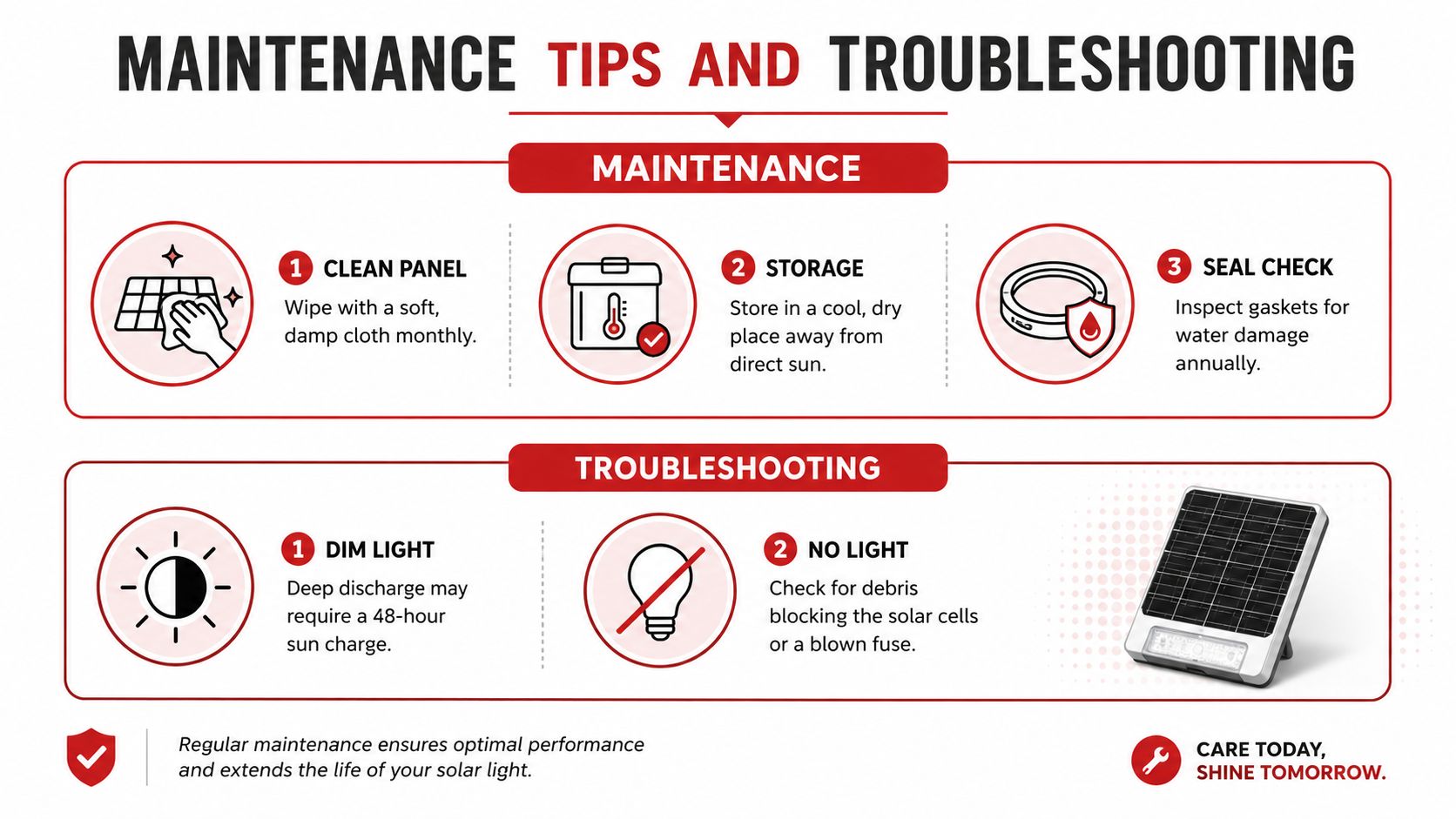
Routine care protects the part of the system that receives the most exposure. The panel collects dust and pollen, seals face rain and condensation, and the battery ages whether the lantern is used often or left in storage.
A simple care routine
- Clean the panel: Wipe the surface with a soft, damp cloth when it becomes dusty or visibly dirty. Readers planning larger solar installations can review this explanation of real solar panel cleaning savings for broader maintenance context.
- Protect the battery: Store the lantern in a cool, dry place, and avoid leaving it in extreme heat or cold.
- Inspect the housing: Check gaskets, seams, covers, and charging ports for signs of water entry or physical damage.
- Test before emergencies: Operate the lantern before storm season or a planned trip, rather than discovering a fault during an outage.
- Manage storage: Keep the light from repeatedly running in a dark emergency bin, and follow the manufacturer's storage guidance for battery charge.
Troubleshooting by symptom
If the lantern doesn't charge, start with the panel. Remove debris, move it into direct sunlight, and check whether the charging indicator responds. A shaded panel can look like a failed battery.
Reduced runtime usually points to insufficient solar exposure, a battery that has aged, or repeated use at high brightness. If stronger daylight and a lower setting don't restore useful operation, the battery may need replacement if the design permits it.
Dim output can result from a low battery state, declining battery capacity, or a driver problem. A light that won't turn on automatically may have an obstructed sensor or may be receiving artificial light near the panel.
The entire unit may need retirement when the housing, wiring, controller, and battery are sealed together and no safe replacement procedure exists. Replacing only the battery makes more sense when the manufacturer supports it and the remaining components are in sound condition.
Choosing the Right Solar Lantern for Your Needs
At a storm-related outage, a lantern that looks bright on the package may provide fewer useful hours than expected. Choose by matching its energy budget to the job. Backpackers often need low weight, a reliable hanging option, and a panel that can collect energy during brief daylight stops. Car campers and emergency kits can carry a larger body if it provides a bigger battery, wider light distribution, or phone charging.
Evaluate the solar panel and battery together. A large battery stores more energy, but an undersized panel may need longer sunlight to refill it. A stronger panel also requires suitable charge-control electronics and battery protection. Battery aging reduces stored capacity over time, while seasonal sunlight, shade, cloud cover, and panel angle affect how much energy reaches it. Check brightness settings, expected runtime at each setting, weather resistance, switch design, charging options, and whether the battery can be serviced.
Match features to the setting
- Backpacking: Favor a packable form, low weight, a dependable hanging point, and modest power needs.
- Car camping: A broad diffuser, tougher construction, and multiple brightness levels may matter more than minimum packed size.
- Emergency preparedness: Choose simple controls, clear charge status, predictable storage behavior, and operation without grid power.
- Backyard use: Consider light distribution, mounting, and whether automatic operation fits the space. Commercial outdoor lighting design ideas can inform placement beyond one lantern.
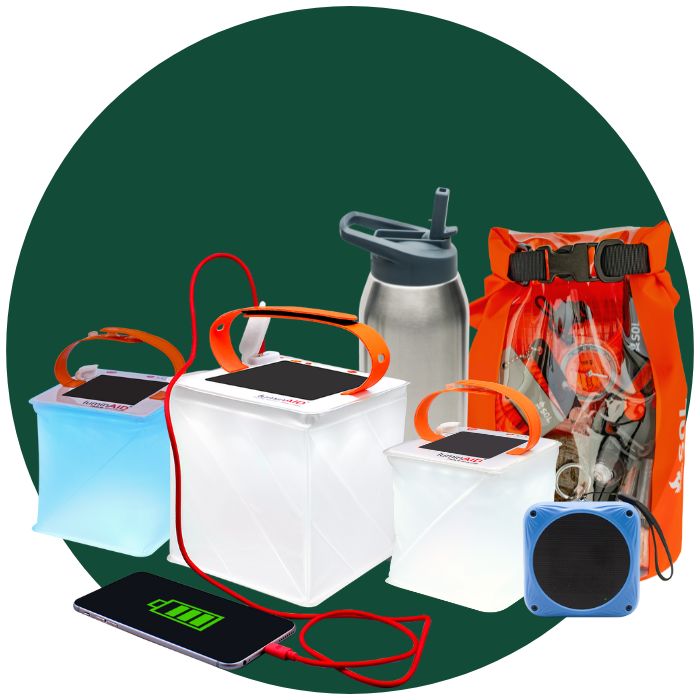
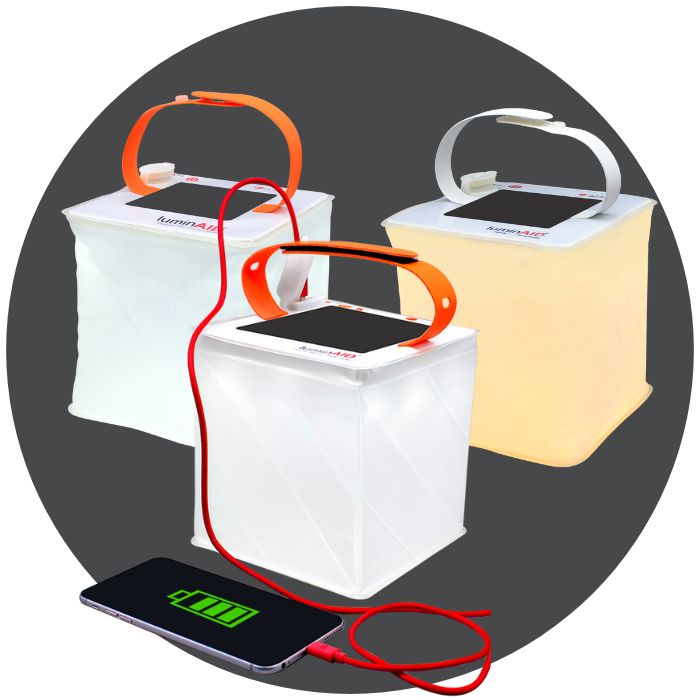
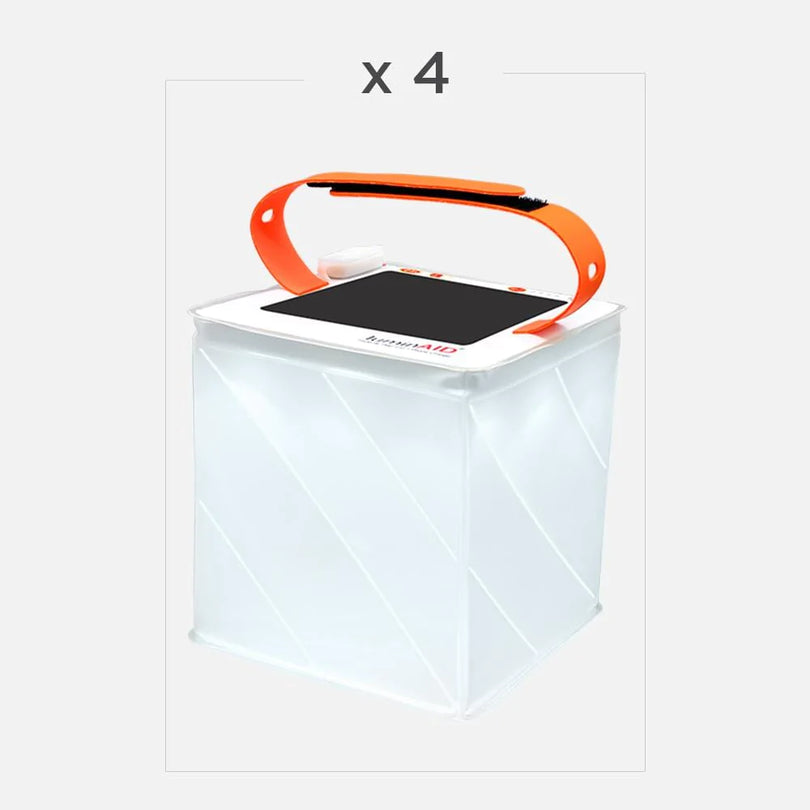
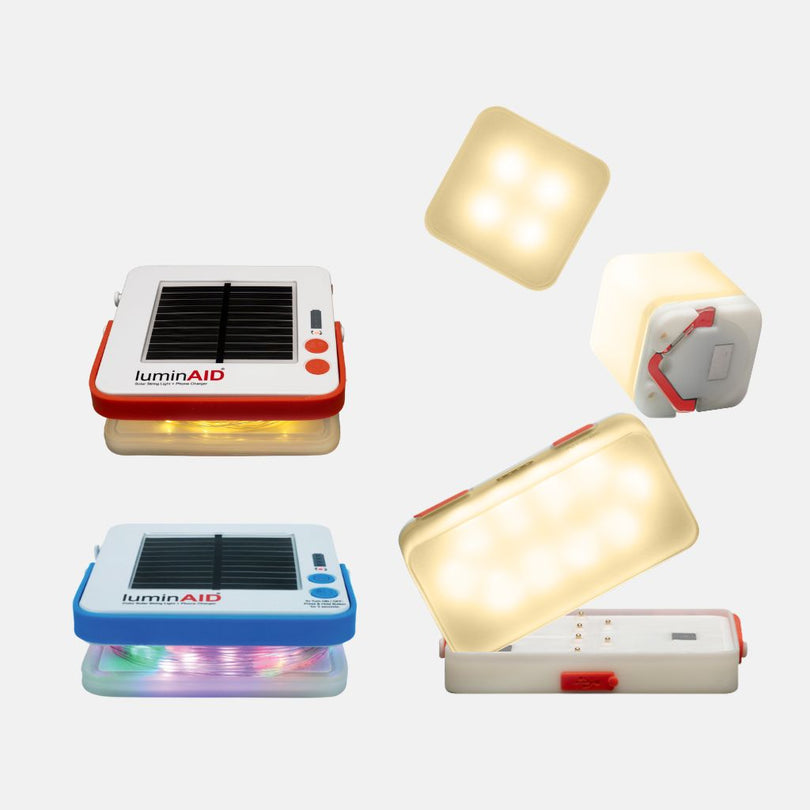
LuminAID's modern solar lantern guide illustrates a portable design that combines lantern operation with phone charging. That feature works only when the battery, solar input, and charging circuit support both demands, so device charging can shorten lighting runtime.
LuminAID offers portable solar lanterns and 2-in-1 phone chargers for camping, emergency kits, and outdoor use. Compare its designs by charging needs, brightness, portability, and preparedness requirements at LuminAID.