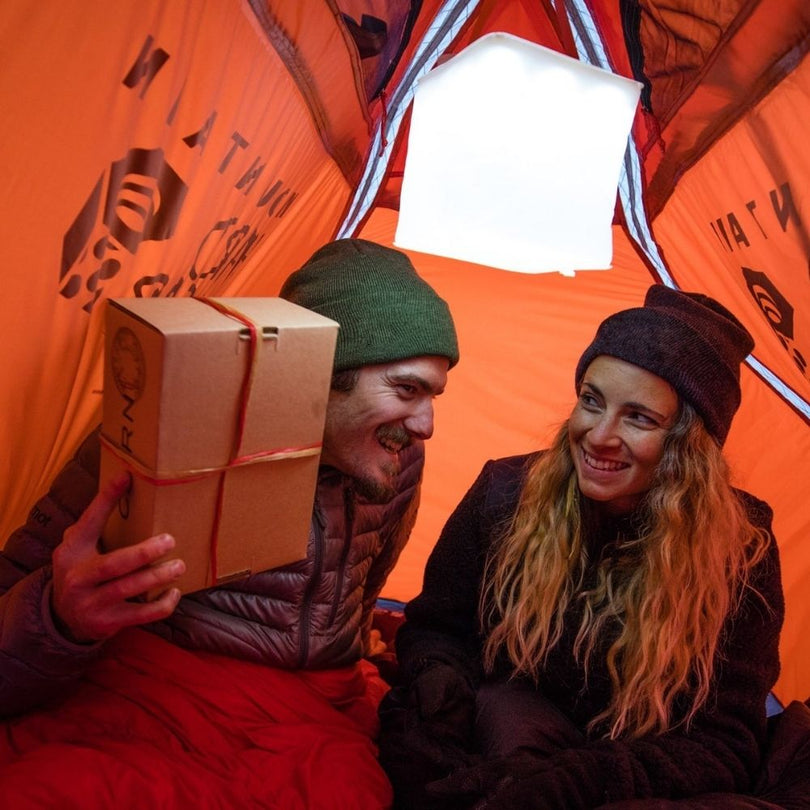
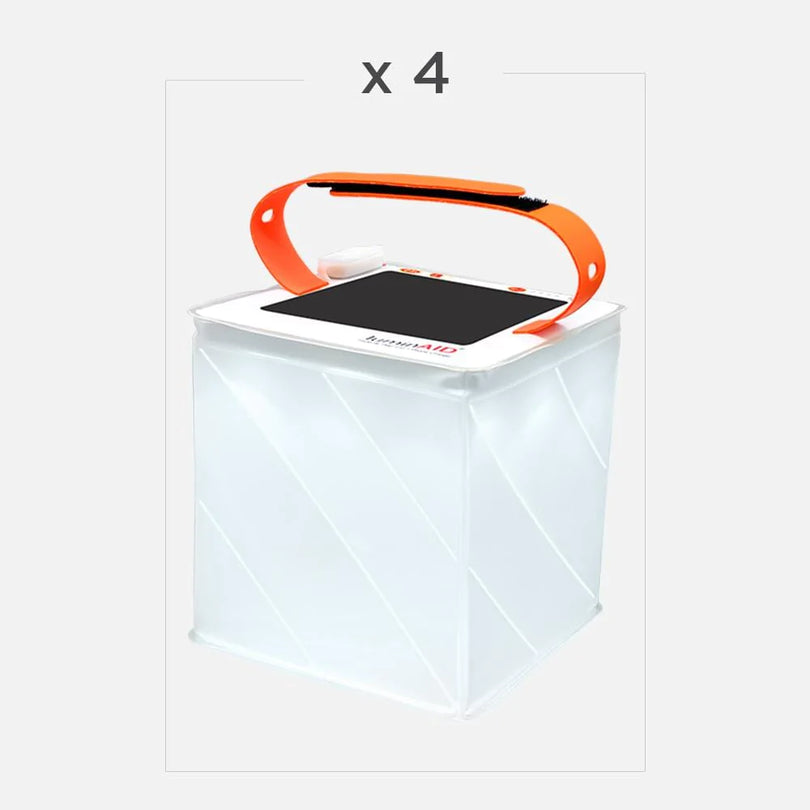

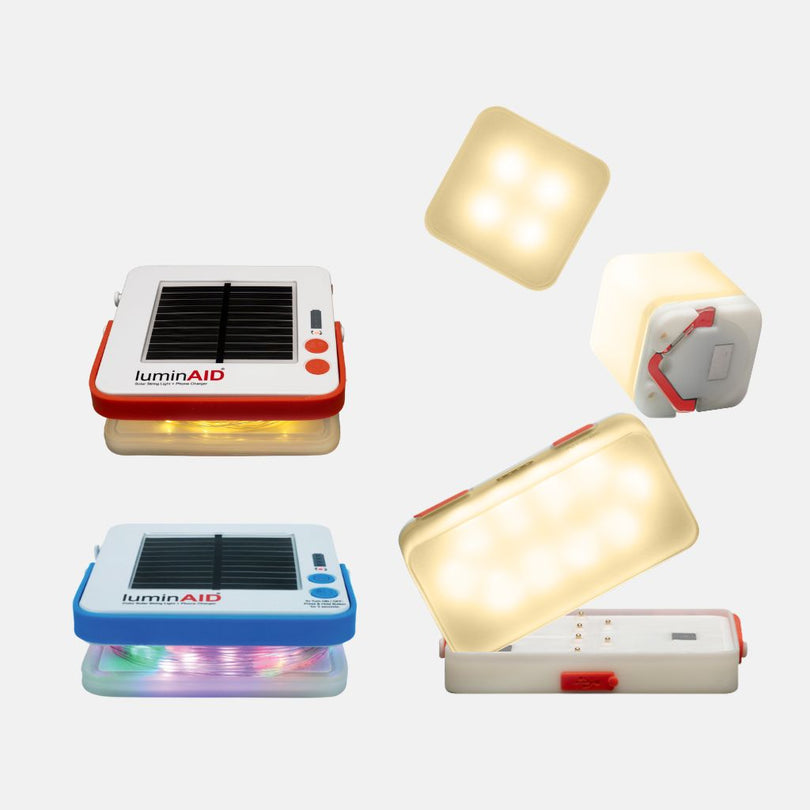
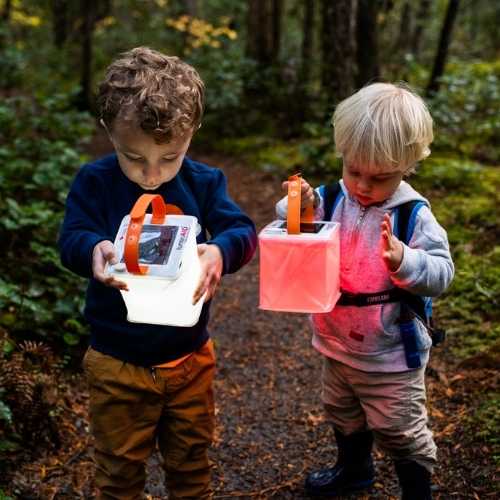

At its simplest, a portable solar power light is a self-contained device that soaks up sunlight, saves it in a battery, and gives you light whenever you need it. Think of it as the ultimate off-grid lighting solution. It offers you complete independence from electrical outlets, which is perfect for camping, your emergency kit, or just lighting up a space that doesn't have power.
It's a straightforward, sustainable way to get reliable light, no matter where you are.
How Portable Solar Power Lights Actually Work
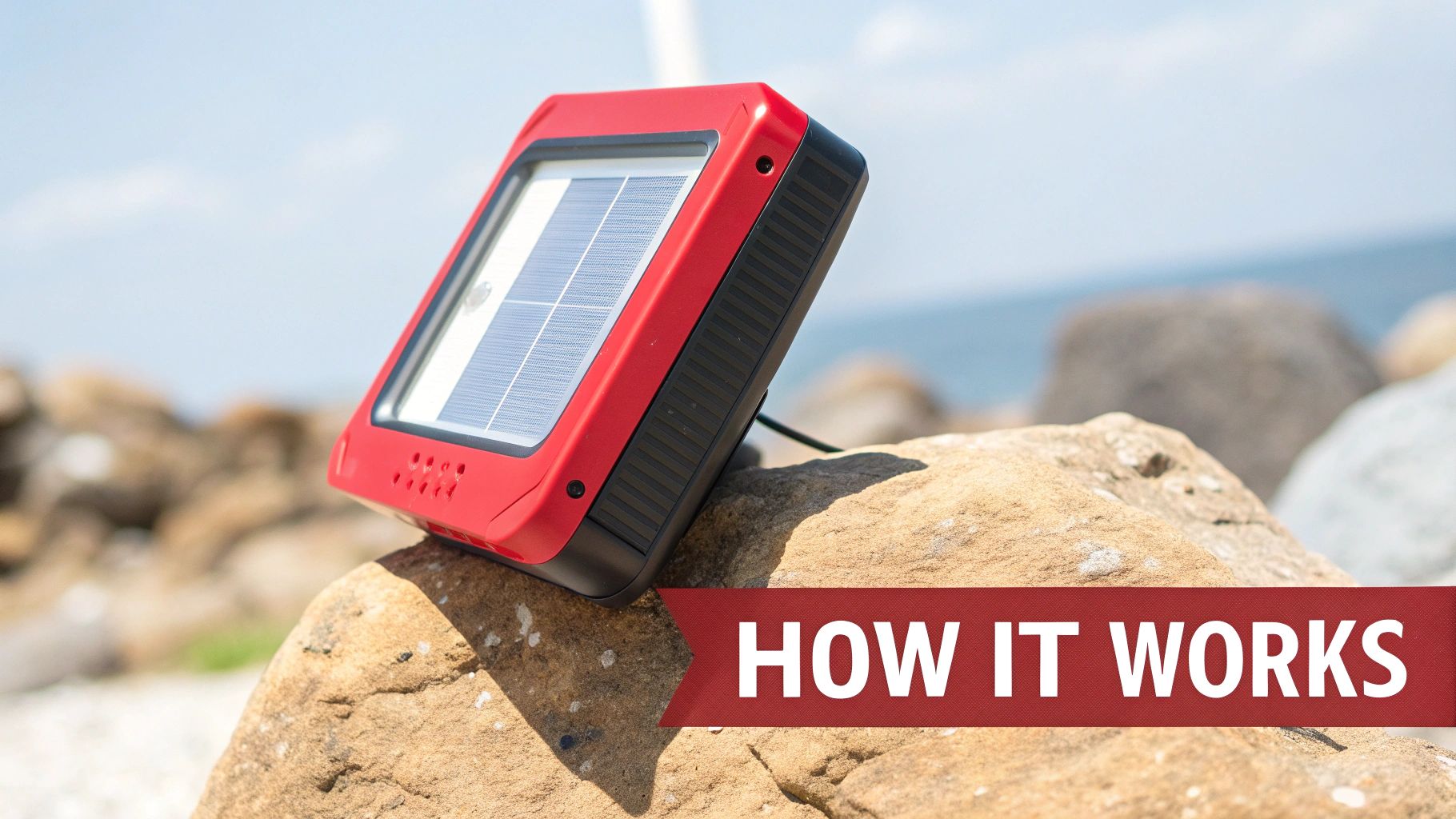
Imagine a portable solar light as a tiny, self-sufficient power plant with a single job: making light. It runs on a simple but brilliant cycle of capturing, storing, and then releasing energy. It's a lot like how a plant uses photosynthesis to store up the sun's energy to get through the night—these lights do the same thing for you.
This elegant process is what makes them so incredibly versatile. They can be the reading light in your tent, a beacon during a power outage at home, or a source of safety for a family in an off-grid community.
The Rise of Portable Solar Technology
The demand for these handy little devices is exploding. The global market for portable solar panels, which is the category portable solar power lights fall into, is expected to jump from an estimated US$1.52 billion in 2025 to over US$4.37 billion by 2032. That’s a compound annual growth rate of 16.3%, showing just how many people are turning to solar for reliable, on-the-go power. You can dive deeper into the market trends over at persistencemarketresearch.com.
This incredible growth boils down to three core benefits that appeal to everyone, from weekend campers to serious emergency preppers.
- Sustainability: By using clean energy from the sun, these lights cut down on our reliance on disposable batteries and fossil fuels. It's a small change that helps minimize your environmental footprint.
- Cost Savings: After you buy the light, the energy is free. There are no surprise electricity bills or costs for replacement batteries, making it a genuinely smart long-term investment.
- Grid Independence: They work anywhere the sun shines. That means you've got a dependable light source during a blackout, at a remote campsite, or in any situation where you just can't plug in. A reliable light is a critical part of any emergency plan.
At its core, a portable solar power light is about freedom. It’s the freedom to explore without limits, the security of being prepared for the unexpected, and the simplicity of harnessing a clean, abundant resource.
To really get a feel for how these devices deliver on that promise, it helps to look at the key parts working together inside.
The Core Components of a Portable Solar Light
Every portable solar light, from the simplest to the most advanced, is built around four essential components. Understanding what each part does helps you appreciate the clever engineering packed into such a small device.
| Component | Primary Function | Why It Matters for You |
|---|---|---|
| Solar Panel (PV Cell) | Converts sunlight directly into electrical energy. | This is the engine of your light. A more efficient panel means faster charging, even on overcast days. |
| Rechargeable Battery | Stores the electrical energy generated by the solar panel. | The battery's capacity determines how long your light will shine after the sun goes down. |
| LED Light | Produces visible light when powered by the battery. | LEDs are incredibly energy-efficient, allowing for longer runtimes and brighter light from a smaller battery. |
| Controller Circuit | Manages the flow of energy to prevent overcharging and discharging. | This tiny brain protects the battery, extending its overall lifespan and ensuring reliable performance. |
Each piece plays a critical role, working in harmony to turn a sunny afternoon into a safely lit night, wherever you might be.
Decoding the Tech Specs That Truly Matter
Shopping for a solar lantern can feel like trying to read a foreign language. The packaging is plastered with numbers and acronyms that don't mean much without a little context. To find the right light for your adventures, you have to look past the marketing hype and understand what these specs actually tell you about performance.
Think of this as your quick-start guide to translating that tech jargon into real-world results. We'll break down the four most important things to look for—lumens, battery runtime, durability rating, and charging time—so you can confidently grab a light that’s perfect for you.
Lumens Unpacked: Brightness in Action
The first number you’ll probably notice is lumens, which is just a measure of brightness. But instead of getting hung up on abstract numbers, it’s way easier to think about what those lumen levels feel like. A higher number means a brighter light, but more isn't always better. Sometimes, you just need a soft glow.
- 10-20 Lumens: This is your personal task lighting. Think of it as the perfect gentle glow for reading in your tent or a soft nightlight for a kid's room during a blackout.
- 50-75 Lumens: This is the sweet spot for all-around use. It’s bright enough to light up a two-person tent or a small picnic table, making it ideal for cooking dinner or playing cards at the campsite. Many LuminAID lanterns have settings right in this range.
- 100-300+ Lumens: Now we’re talking about serious illumination. This kind of power can light up an entire campsite, a backyard get-together, or a large room during an emergency. It's enough light to keep group activities going and make everyone feel safer.
Knowing these ranges helps you match the lantern’s power to what you’ll actually be doing, so you're not left fumbling in the dark or accidentally blinding your friends.
Battery Capacity and Runtime: The Power Duo
While lumens tell you how bright a light is, battery capacity and runtime tell you how long it can stay that way. Capacity is measured in milliampere-hours (mAh). You can think of it like the size of a gas tank—a bigger number means more energy stored inside.
Runtime is the direct result of that capacity. It’s the estimated number of hours the light will last on a full charge. But here's the catch: these two specs are always in a trade-off with brightness. A lantern might boast an impressive 50 hours of runtime, but that’s almost always on its dimmest setting. Crank it up to its brightest mode, and that same light might only last for a few hours.
When you're comparing solar lights, always look for the runtime at a specific lumen level. A quality product will spell it out for you.
This relationship is crucial for planning. If you need a light to get you through a multi-day power outage, you’ll want a model with a beefy battery and several brightness settings to help you conserve power when you need it most.
IP Ratings: How Tough Is Your Light?
Outdoor gear is meant to be used, well, outdoors. That’s where IP ratings come in. This standardized system tells you exactly how well a device can handle solids (like dust and sand) and liquids (like rain and splashes). The rating always looks like "IP" followed by two numbers.
- The First Number (Solids): This digit, from 0 to 6, measures protection against solid stuff. A rating of 6 means the device is completely dust-tight, which is a must-have for desert camping or windy beach trips.
- The Second Number (Liquids): This one goes from 0 to 9 and measures water resistance. A rating of 7 (as in IP67) means the light can be submerged in up to a meter of water for 30 minutes. That level of waterproofing is a game-changer for kayaking, fishing, or just surviving an unexpected downpour.
A light with a high IP rating like IP67 gives you incredible peace of mind. It’s a sign of tough, reliable construction, ensuring your light won't quit on you, no matter what the weather decides to do. For any serious adventure, a waterproof light is as essential as having good insect repellent from a brand like Ben's.
Charging Time: Setting Realistic Expectations
Finally, let's talk about charging time. Solar lights usually offer two ways to charge up: solar and USB. Each has its own timeline.
Solar charging is amazingly convenient, but it's totally dependent on the sun. On a clear, bright day, a typical lantern might take 10-14 hours of direct sunlight to get a full battery. If it's an overcast day, that time can easily double. It’s a bit of a waiting game.
For a faster, more predictable charge, many modern lanterns also have a USB port. Plugging into a power bank or a wall outlet can top off the battery in just 1-2 hours. This dual-charging capability gives you a ton of flexibility, making sure your light is always ready to go when you are.
Choosing the Right Light for Your Adventure
Okay, you can now translate the tech specs on the box. It's time for the fun part: matching a portable solar power light to your specific mission.
Not all lights are created equal. The perfect lantern for a weekend camping trip might be a terrible choice for a home emergency kit. By figuring out your main reason for needing one, you can focus on the features that actually matter.
We’ll break it down for three common scenarios: camping and backpacking, home emergency preparedness, and humanitarian aid. Each situation calls for a different mix of portability, power, and toughness. Knowing what to look for is the key to making sure your light never leaves you in the dark.
This is all about moving from specs on a page to real-world performance.
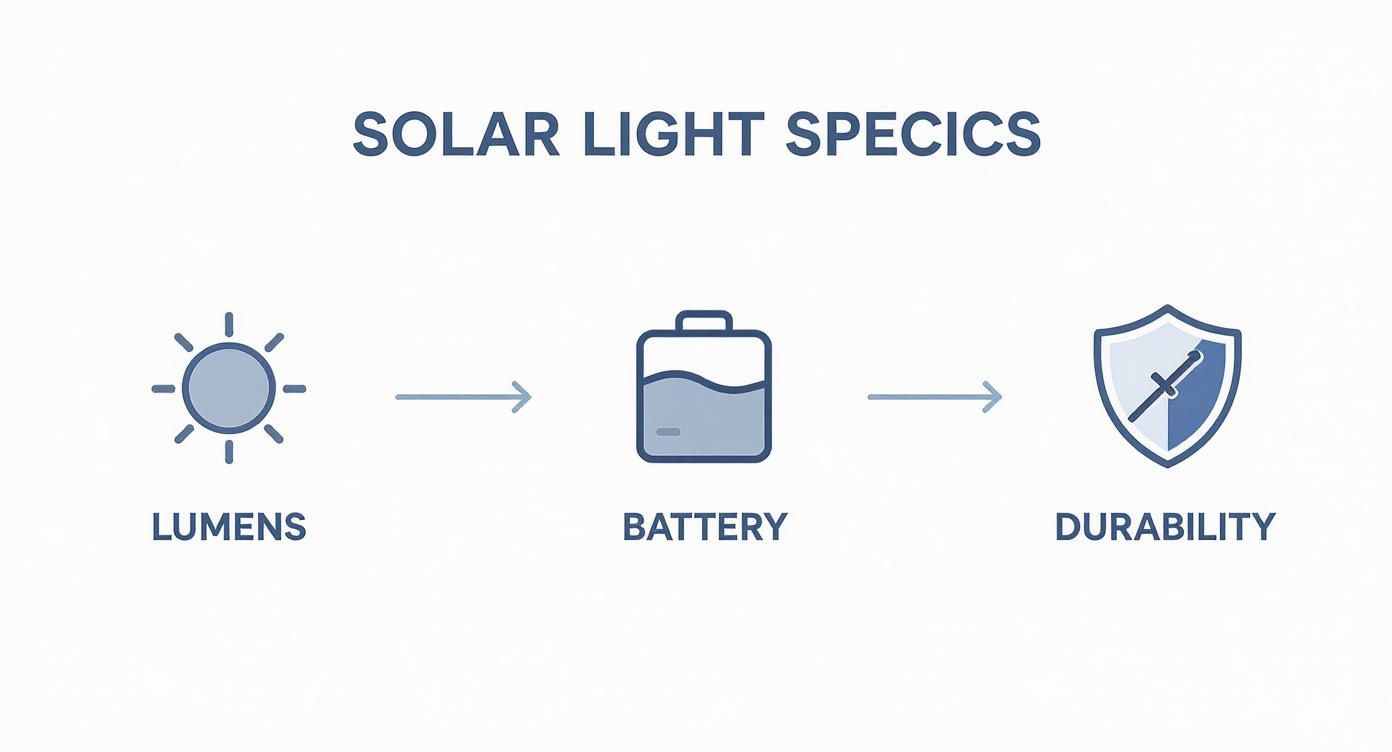
As you can see, these three elements—lumens, battery, and durability—are all tied together. Tweaking one almost always affects the others, and that balance is what determines how a light will perform when you need it most.
For Campers and Backpackers
When you’re carrying everything on your back, every single ounce counts. For backpackers and campers, the best portable solar lights are all about lightweight construction, a compact design, and rugged durability. You need gear that can handle being stuffed into a pack, dropped on a trail, and hit with whatever weather the mountain throws at you.
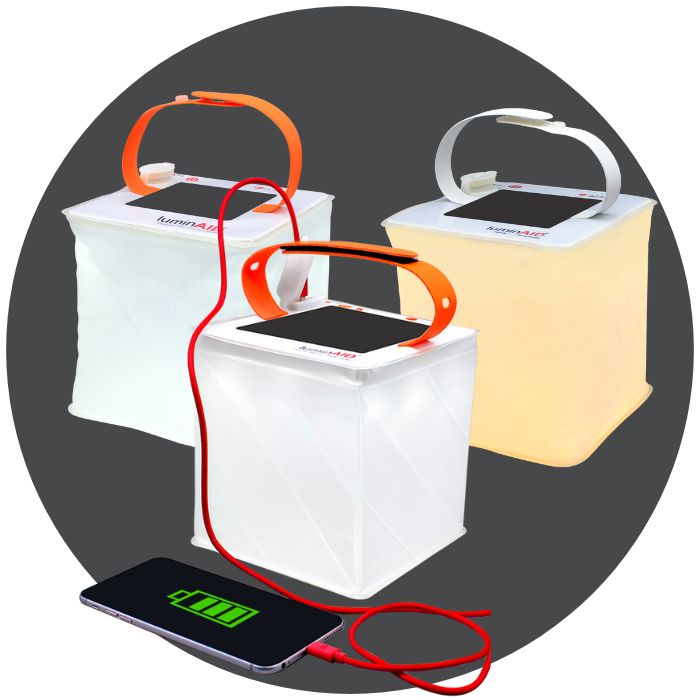
This is where clever designs like foldable or inflatable lanterns really shine. They pack down almost completely flat, taking up barely any space and weighing next to nothing. Once you're at the campsite, they expand to cast a wide, soft light that’s perfect for lighting up a tent or a small cooking area without harsh shadows.
A high IP rating (like IP67) is non-negotiable here. It's your guarantee that the light will survive a sudden downpour or even an accidental dunk in a lake.
For Home Emergency Preparedness
When a storm knocks out the power, your priorities change completely. For a home emergency kit, portability is less about weight and more about reliability and sheer endurance.
The key features to look for are long runtimes, multiple brightness settings, and the ability to do more than just one thing. A light that can last for days on its lowest setting is an absolute game-changer when you have no idea when the grid will be back up.
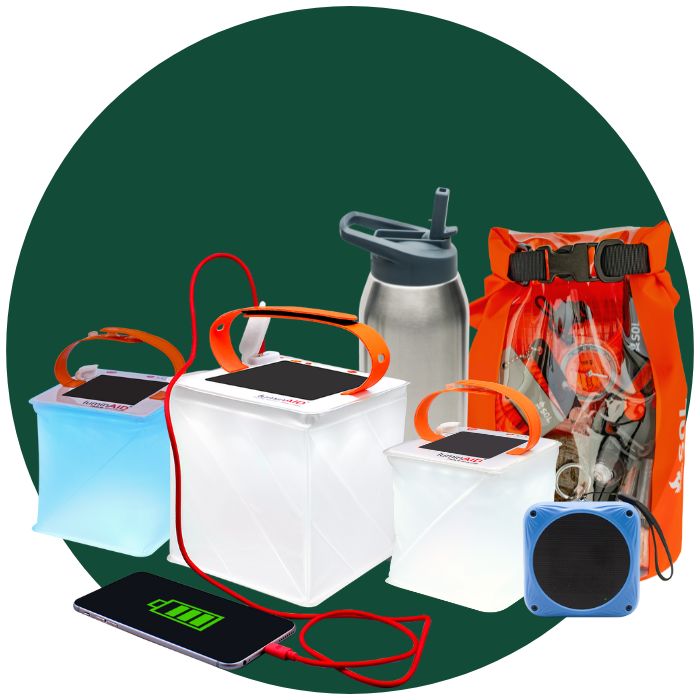
Many of the best emergency solar lights also have a USB output port, turning your lantern into a small power bank. Sure, it won't fully charge a modern smartphone, but it can provide enough juice for a crucial emergency call or to check weather alerts. A solid emergency kit is built on multi-functional tools, making a reliable light a cornerstone—just as essential as first-aid supplies.
A prepared home is a safe home. In an emergency, a dependable solar light provides not just illumination but also a sense of security, control, and normalcy when the world outside feels chaotic.
This move toward self-sufficiency is a growing trend. The market for portable solar chargers—which use the same core tech—was USD 5.2 billion in 2024 and is expected to hit USD 22.8 billion by 2033. This surge shows a clear demand for reliable off-grid power, both for fun and for readiness.
For Humanitarian Aid and Off-Grid Living
In a humanitarian crisis or for daily life in an off-grid community, a portable solar light is more than a convenience—it’s a life-changing tool. For these situations, the most important features are extreme durability, simplicity of use, and maximum efficiency.
The light has to withstand harsh environments and daily use for years without failing. Complex features become a liability; what’s needed is a straightforward, dependable device that anyone, from a child to an elder, can use without a manual. The design must be tough enough to survive dust, heat, and moisture, providing a safe and reliable light source for children to study, families to cook, and health workers to provide care long after the sun goes down.
This is the entire principle behind LuminAID’s Give Light program. Individuals can sponsor lights that our partner NGOs distribute to communities affected by disasters or living without electricity. It shows how a simple piece of technology can deliver safety, opportunity, and hope.
Which Features Matter Most for Your Needs?
To make it even simpler, here's a quick breakdown of what to prioritize for each use case.
| Feature | Camping & Backpacking | Home Emergency Kit | Humanitarian & Off-Grid |
|---|---|---|---|
| Weight & Portability | Critical. Must be lightweight and packable. | Important. Should be easy to move and store. | Moderate. Durable design is more important. |
| Durability (IP Rating) | Critical. Needs to be waterproof and dustproof. | Important. Should withstand storage and drops. | Critical. Must endure years of daily, harsh use. |
| Runtime | Important. Needs to last through the night. | Critical. Longer is always better. | Critical. Must be reliable night after night. |
| Brightness (Lumens) | Important. Adjustable settings are ideal. | Important. Multiple modes for task vs ambient. | Important. Bright enough for reading or work. |
| Charging Time | Important. Fast solar charging is a huge plus. | Moderate. Can be charged ahead of time. | Critical. Must charge efficiently in varied sun. |
| Extra Features | Helpful. Red light mode, carabiner clips. | Critical. Phone charging (USB out) is key. | Not a priority. Simplicity and reliability rule. |
By carefully thinking through your own needs, you can find the perfect model among the many excellent portable solar lanterns available today.
Maximizing the Life of Your Solar Light
A high-quality portable solar light is a fantastic investment, and with just a little care, you can make sure it runs reliably for years. Think of it less like a disposable gadget and more like a trusty piece of gear that just needs a bit of attention every now and then.
It all starts the moment you get it out of the box. Getting that very first charge right sets the stage for a long, healthy battery life and helps you avoid common issues down the road.
The All-Important First Charge
Before you even think about heading outdoors, the single best thing you can do for your new light is give it a full, uninterrupted charge. It’s tempting to just toss it in the sun right away, but for this first time, use the included USB cable.
Plugging it into a wall adapter ensures the lithium-ion battery gets a stable, complete charge, which helps calibrate it. This initial "conditioning" allows the battery to reach its maximum potential and gives you a solid baseline for all future solar charging. It’s a small, one-time step that makes a huge difference in long-term performance.
Just like breaking in a new pair of hiking boots before a big trek, conditioning your solar light's battery ensures it's ready for the trail. This first charge sets it up for peak performance when you're relying on it most.
Once that’s done, you can start harnessing the power of the sun with confidence, knowing the battery is fully prepped and ready to go.
Pro Tips for Optimal Solar Charging
Getting the most out of the sun isn't complicated, but a little strategy goes a long way. Simply leaving your light out is a start, but a few small adjustments can seriously speed up charging times, especially on those cloudy days.
- Follow the Sun: For the fastest charge, you want direct, unobstructed sunlight. As the sun moves, try to reposition the panel every few hours to keep it aimed right at the rays.
- Keep It Clean: Dust, pollen, and trail grime can build up and act like a film, blocking sunlight and slowing things down. A quick wipe with a soft, damp cloth is usually all it takes to get it back to full charging power. For a deep dive, check out this great a DIY guide for cleaning solar panels which has some handy tips. You can also find specific instructions on how to charge your LuminAID light.
- Avoid Dashboards: It might seem like the perfect spot, but charging a light on a car dashboard can cause it to overheat. Over time, that heat can damage the battery. Always find a well-ventilated spot with direct sun exposure.
Smart Storage for Long-Term Health
What you do when you’re not using your light is just as important as how you charge it. Storing it correctly, especially for long periods, is the key to preventing battery degradation.
If you’re packing your light away for a few months—maybe in an emergency kit or over the winter—try not to store it completely full or completely empty. Lithium-ion batteries don't like being stored at those extremes; it puts stress on their components.
The sweet spot is a charge level of around 50-75%. Store it in a cool, dry place away from direct sunlight, and it will be ready to go the next time you need it.
Bringing Solar Lights into the Real World
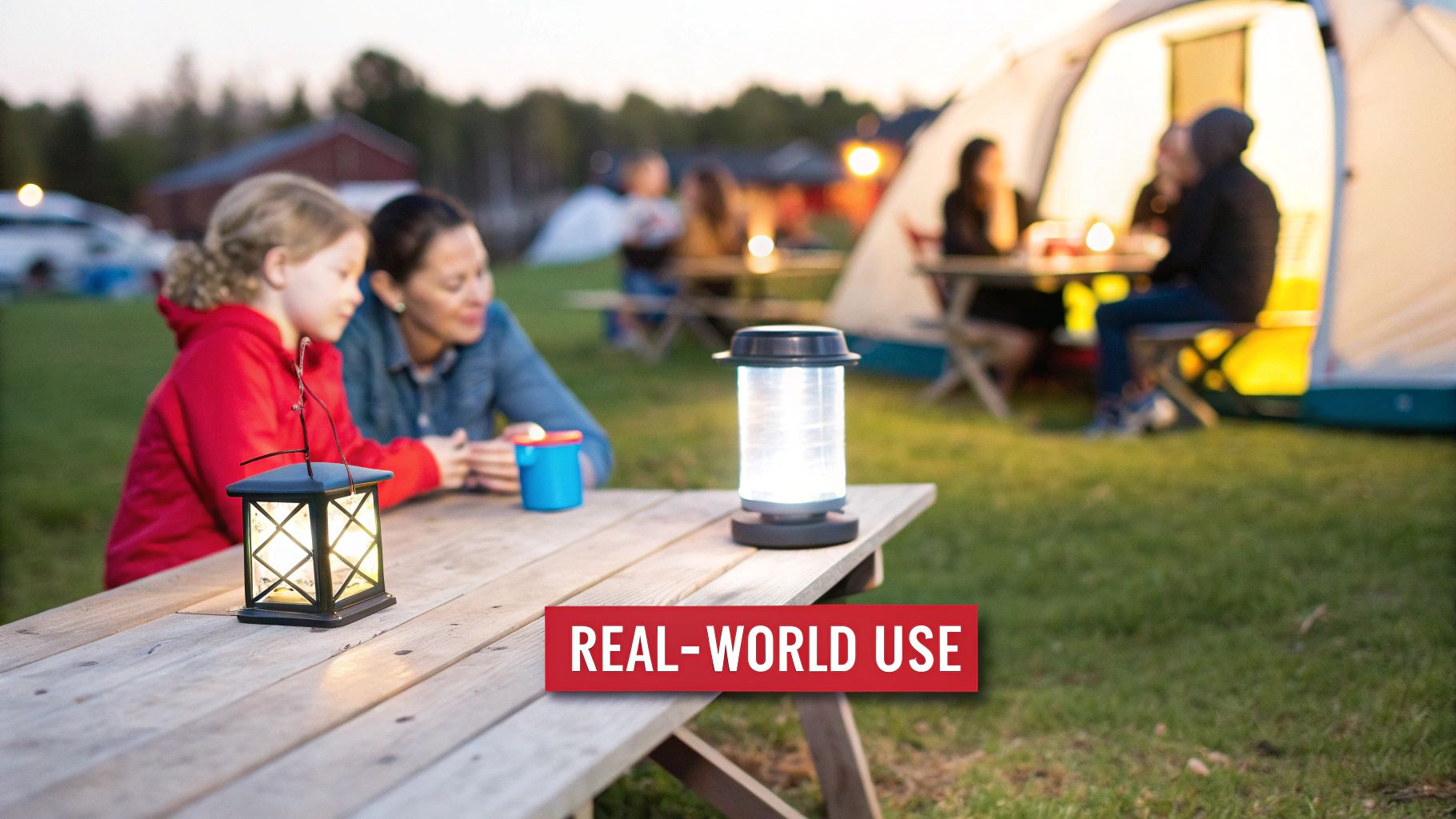
Technical specs are one thing, but the real magic of portable solar power lights happens when you see them in action. These aren't just gadgets; they're problem-solvers, safety nets, and sources of comfort when you need them most. The best way to grasp their impact is to imagine them lighting up our daily lives and biggest adventures.
Picture a family on a weekend camping trip. As twilight settles over the woods, they're not fumbling with dim, battery-hungry headlamps. Instead, a solar lantern hangs from a tree branch, casting a warm, steady glow over their entire picnic table. Dinner is easy to see and cook, and afterward, that same light lets them play a round of cards, creating memories long after the sun goes down.
From Backcountry Trails to Blackouts at Home
Now, think about a thru-hiker on a remote mountain trail. A lightweight, inflatable solar light is clipped to their backpack, soaking up UV rays all day. It weighs mere ounces and takes up almost no space, yet when they set up camp for the night, it provides all the light they need to organize their gear and plan the next day’s route. Because it’s waterproof and durable, it just works, rain or shine.
But these scenarios go far beyond recreation. Imagine a homeowner plunged into darkness during an unexpected power outage. Instead of dealing with risky candles or a single, narrow flashlight beam, they have a set of portable solar lights ready to go. They can safely move through their home, keep the kids calm in a well-lit living room, and even use a model with a USB port to give their phone a crucial bit of power. When putting together an emergency kit, it's wise to include gear for multiple scenarios, like a survival blanket from Survive Outdoors Longer.
A Global Shift Toward Portable Power
This growing reliance on off-grid solutions is a clear trend. In 2023 alone, over 10 million portable solar panel units were shipped globally—a sure sign that devices like solar power lights are going mainstream. This growth is fueled by better technology, with about 65% of panels now being monocrystalline for improved efficiency and a longer lifespan.
It all points to the practical benefits that are convincing more people to swap out their old battery-powered lanterns for solar alternatives. And as people integrate these lights into their outdoor spaces, some are even looking into AI-driven lighting placement strategies for landscapes to get the most out of them.
In moments of uncertainty—whether it's a storm on the horizon or an unfamiliar campsite after dark—a dependable source of light provides more than just visibility. It offers a sense of security, control, and normalcy.
Finally, think about the humanitarian impact. Aid workers in remote communities use LuminAID lights to bring safety and opportunity where electricity is nonexistent. A single light lets a child study after dark, helps a midwife safely deliver a baby, and allows a family to gather without breathing in toxic fumes from a kerosene lamp. In these real-world situations, a simple solar light becomes a powerful tool for progress.
Answering Your Top Solar Light Questions
Even after getting the hang of how they work and what to look for, you might still have a few questions about portable solar power lights. That’s perfectly normal. We've put together some of the most common queries we hear from outdoor adventurers, emergency preppers, and everyday users to clear things up.
Think of this as your quick-reference guide for those practical, real-world details that make a huge difference when you’re out on the trail or riding out a storm at home. By the end, you'll have the complete picture and feel totally confident in your gear.
Do Portable Solar Lights Work on Cloudy Days?
Yes, they absolutely do, but it's good to know what to expect. Modern solar panels are pretty efficient and can generate a charge even from indirect or ambient sunlight. This means that even on a gray, overcast day, your light is still soaking up energy.
The catch is that the charging process will be a lot slower than on a bright, sunny day. A charge that might take 10 hours in direct sun could easily take twice as long under heavy cloud cover. To get the most out of it, just make sure the panel is clean and pointed toward the brightest spot in the sky. This is also a huge reason why having a model with a backup USB charging port is such a game-changer for always having power when you need it.
How Long Do the Batteries in These Lights Last?
The lifespan of the rechargeable batteries in quality solar lights is impressive—they’re built to last for years of regular use. Most use lithium-ion or lithium-polymer batteries, which are typically rated for 500 to over 1,000 charge cycles.
A "charge cycle" just means going from fully charged to fully discharged and back again. So, you can use and recharge your light hundreds, if not thousands, of times before you'll notice a serious drop in battery life. You can stretch this out even longer by following simple best practices, like not letting the battery die completely and storing it with a partial charge. A little care ensures your light will be ready for countless adventures to come.
Think of the battery's lifespan not in months or years, but in cycles of use. A well-cared-for solar light can easily outlast dozens of packs of disposable batteries, making it a far more sustainable and reliable long-term solution.
Can I Use My Solar Light to Charge My Phone?
Some of them, yes! But it’s super important to check the specs before you buy. Many portable solar lights, especially those designed with emergencies in mind, come with a USB-out port just for this. This feature turns your light into a handy little power bank, which can be a real lifesaver.
It's important to have realistic expectations, though. The battery in a typical solar lantern is mainly designed to power its own LEDs. It will likely give a modern smartphone a partial charge—enough for an emergency call or to check a map, but probably not a full top-up. If charging other gadgets is a top priority, look closely at the light's battery capacity (measured in mAh) or consider a dedicated solar power bank.
Are Inflatable Solar Lights Actually Durable?
Absolutely. It’s a common myth that being lightweight and inflatable makes them fragile, but for high-quality models, the exact opposite is true. Inflatable lanterns from brands like LuminAID are engineered specifically for rugged, real-world use.
They're usually made from tough, puncture-resistant, and waterproof materials like TPU (thermoplastic polyurethane), which is both flexible and incredibly resilient. The inflatable design itself is a massive win for anyone counting ounces or saving space:
- Ultralight: They weigh next to nothing.
- Highly Packable: They fold down completely flat, taking up almost no room in a backpack or emergency kit.
- Buoyant: They float! This makes them perfect for kayaking, boating, or any situation near water.
This blend of durability and portability makes them a fantastic choice for backpackers, thru-hikers, and anyone who needs a dependable light that won’t weigh them down.
At LuminAID, we’re all about creating dependable, innovative lighting that’s ready for any adventure or emergency. Our solar lanterns and 2-in-1 phone chargers are designed with the real-world challenges of off-grid life in mind, ensuring you have safe, sustainable light and power whenever and wherever you need it. Explore our collection today and find the perfect light to brighten your world.