


The lights flicker while dinner is still on the stove, the kids are finishing homework, and the fridge keeps humming like nothing is wrong. Then the room goes quiet, the Wi-Fi dies, and everybody starts asking the same question, how long is this going to last?
That moment is why emergency power backup matters. It is not just about comfort, it is about keeping a few critical things working when the grid doesn't. The CDC says the average U.S. household experiences about 4 hours of power loss per year and recommends emergency lighting, extra batteries, a battery-powered or hand-crank NOAA weather radio, and backup power for critical devices and medical equipment (CDC guidance). For families, renters, RV travelers, and community responders, the key question is not whether a blackout will happen, but which loads should stay on and for how long.
That broader planning mindset also shows up in everyday preparedness, from keeping medications cold to protecting documents. A practical place to start is to safeguard family documents before emergencies, because backup power works better when the rest of the household plan is already in place.
Table of Contents
- Why Emergency Power Backup Matters More Than You Think
- What Counts as Emergency Power Backup
- Comparing the Main Types of Backup Power
- How to Calculate What You Actually Need
- Matching Backup Power to Real-World Scenarios
- Safety and Maintenance Habits That Keep Backup Power Working
- Putting It All Together with Printable Prep Checklists
Why Emergency Power Backup Matters More Than You Think
A storm doesn't have to be historic to be disruptive. One family can lose power for a few hours and still end up with spoiled food, dead phones, and a house that feels strangely unsafe once the sun goes down. A medical device user can go from routine to urgent in minutes if there's no plan for the next socket, the next battery, or the next ride.
The scale of outages is the reason this topic isn't a niche concern. FEMA notes that the August 2003 Northeast Blackout left more than 50 million people without power for up to four days, and the August 1996 blackout affected over 7.5 million people across the United States, Canada, and Mexico, with outages lasting from minutes to as long as nine hours (FEMA blackout and outage record). FEMA also records Hurricane Katrina in 2005 as cutting power to an estimated 2.7 million customers across five states, with some areas taking weeks to restore service (FEMA power-outage annex). Those are the kinds of events that turn backup power from a convenience into a resilience tool.
Who this matters for
Homeowners usually think about the fridge, the router, and maybe a lamp. Renters often need a smaller, more portable setup that doesn't assume permanent installation. RV owners, campers, and disaster-relief teams need something even more flexible, because power needs change from one location to the next.
Practical rule: backup power planning starts with the loads that keep life stable, not with the biggest device in the catalog.
That mindset also helps with the less obvious jobs. A medical device household may need power for charging, refrigeration, communication, and transportation planning, not just a light bulb. A community shelter may need egress lighting, network equipment, and other life-safety loads, which is why the load list matters more than the battery sticker.
What Counts as Emergency Power Backup
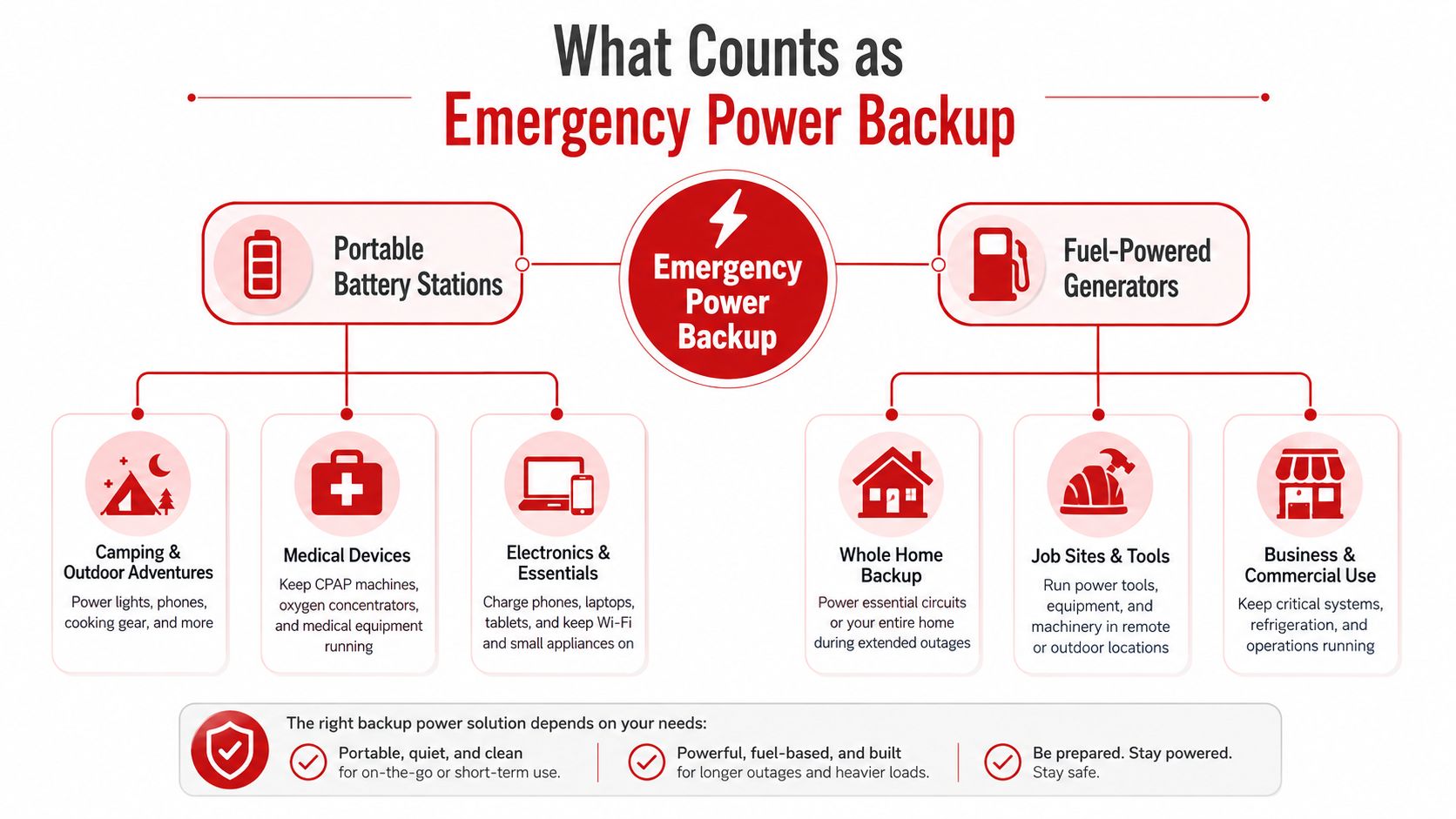
Emergency power backup is any system that keeps selected devices running when the normal grid stops doing its job. The simplest way to think about it is this. The grid is a river, and backup power is the cistern, well, or fuel tank sitting behind the house, ready when the water stops flowing.
FEMA's critical-facility guidance recognizes two common method families, stored energy devices and standby/emergency generators (FEMA emergency power guidance). Stored energy includes batteries, inverter systems, UPS units, and portable power stations. Generators use fuel, which can mean gasoline, propane, or in some applications fuel cells.
The two terms that confuse most buyers
Transfer time is the pause between grid power failing and backup power taking over. Some emergency backup systems can take several seconds to switch over, while the return to grid power can be almost instant (Ferroamp emergency power datasheet). That matters because sensitive electronics can shut off if the handoff is too slow.
Waveform quality describes how clean and stable the power looks to the device. That's why a UPS and a camping power station are not interchangeable. A UPS is meant to protect sensitive loads with fast response and conditioned output, while a general-purpose battery station may be better suited to phones, lights, and small appliances.
The same source lists standard household-grade AC output, very high efficiency at moderate load, and built-in protection against common electrical faults (Ferroamp emergency power datasheet). That is why the engineering details matter. Backup power is not just stored energy, it's stored energy delivered in a form the device can actually use.
For emergency lighting and small backup systems, a useful consumer-friendly overview is available in this LuminAID resource on emergency lighting for power outages. It's a helpful way to see how light, runtime, and portability fit together in real life.
Comparing the Main Types of Backup Power
The mistake is choosing a power source before choosing the load. A fridge for a few hours, a CPAP machine overnight, and a whole-house backup plan are three different problems, even if all three are called “backup power.”
The cleanest way to compare the main options is by runtime, indoor safety, noise, maintenance, and the kind of interruption each one can handle. For household planning, a simple battery sizing tool like thecalcs battery calculator can help turn “roughly enough” into a more disciplined estimate before any purchase is made.
Emergency Power Backup Types Compared
| Type | Typical Runtime | Indoor Safe | Noise | Maintenance | Best For |
|---|---|---|---|---|---|
| Rechargeable battery bank | Short, device-level | Yes | Silent | Low | Phones, tablets, small electronics |
| Portable power station | Hours to a day, depending on load | Yes | Silent | Low to moderate | Lights, routers, medical devices, small appliances |
| Uninterruptible power supply (UPS) | Minutes to a short bridge window | Yes | Silent | Low | Desktops, network gear, sensitive electronics |
| Fuel generator | Longer, fuel-dependent | No | Noticeable | Higher | Extended outages, larger loads, field operations |
| Solar generator | Varies with battery size and sunlight | Yes | Silent | Moderate | Portable resilience, recharge during daylight |
Why the categories aren't interchangeable
A UPS is not trying to run everything for a weekend. It's built to bridge a gap, protect electronics, and keep critical digital gear alive through a transfer event or short outage. A portable power station is more flexible, but it still lives in the world of battery capacity, inverter limits, and planned loads.
A fuel generator solves a different problem. It trades silence and indoor safety for longer support when fuel is available, which is why it remains common in larger outage plans. The U.S. Department of Energy says commercially available fuel cell backup power systems are best suited to smaller backup jobs and usually cost more to install than diesel systems or batteries when incentives are not part of the equation (DOE fuel cell backup fact sheet).
FEMA's public-safety framing keeps the choice simple. Some critical loads are best handled by stored energy devices, others by standby generators (FEMA emergency power guidance). If the load is small and indoor use matters, battery-based options usually fit better. If the load is larger or the outage is long, fuel-based systems become more relevant.
For a second planning lens, the home-backup overview at LuminAID's home backup power resource is a practical companion piece because it keeps the focus on use case instead of brand noise.
How to Calculate What You Actually Need
Sizing backup power gets easier once the work is broken into a few plain steps. Start with the loads that matter, then estimate how long each one needs to run. The goal is not to power the whole house by default, it's to protect the parts of life that become a problem fastest.
A simple sizing workflow
- List critical devices. Think fridge, router, CPAP, phone charging, lamps, or a medical cooler.
- Note the wattage. Check the label or manual. If the device has multiple modes, use the higher realistic number.
- Estimate daily runtime. A fridge doesn't run continuously, but a medical device or router might need longer coverage.
- Convert to watt-hours. Multiply watts by hours for each device, then add the totals.
- Add a buffer. Allow extra room for inverter losses, battery aging, and a little unexpected use.
That buffer matters because real outages rarely match the spreadsheet exactly. A family may end up charging a phone one more time than expected, or running a light longer because the power hasn't come back before bed. A modest margin keeps the system useful instead of fragile.
Use the runtime target first, then pick the hardware. If the load list says the family needs overnight phone charging, a few hours of light, and a medical device bridge, the battery size follows from that.
Where to be conservative
Emergency lighting guidance often uses about an hour and a half of runtime as a minimum benchmark for some systems, and NFPA says critical storage batteries need regular inspection, maintenance, and periodic testing based on their assigned role (NFPA emergency power guidance). That is a good reminder that runtime should match the situation, not be guessed from battery size alone.
A useful companion reference for the math behind storage capacity is LuminAID's watt-hour sizing guide. It's especially handy for readers who want to turn device lists into a real target without doing the algebra twice.
Matching Backup Power to Real-World Scenarios
A backup system works best when it matches the setting. A homeowner in hurricane season, an RV traveler, a backcountry camper, and a disaster-relief volunteer all need power, but they don't need the same kind of power.
Home outage, RV life, backcountry use, and relief work
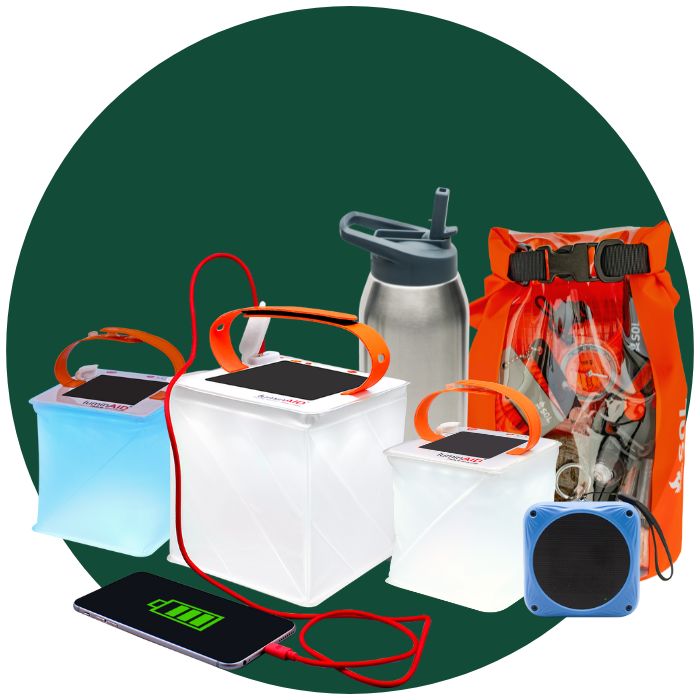
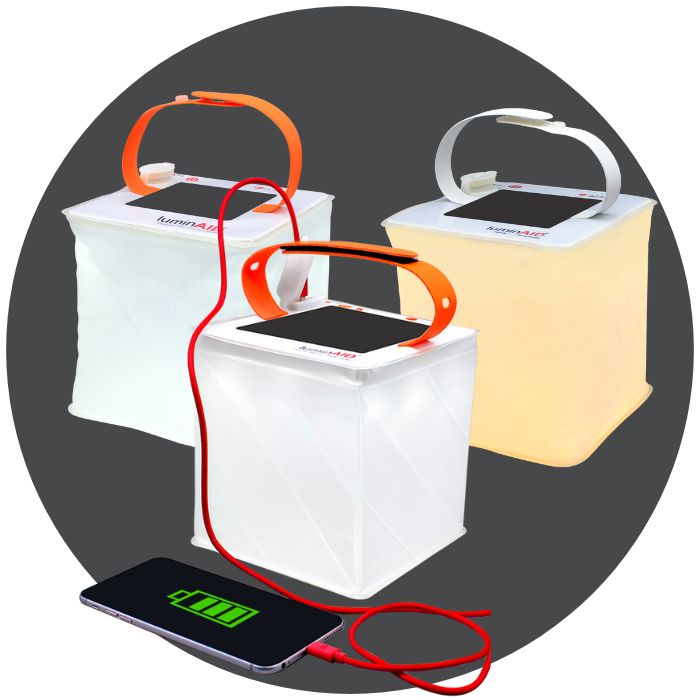
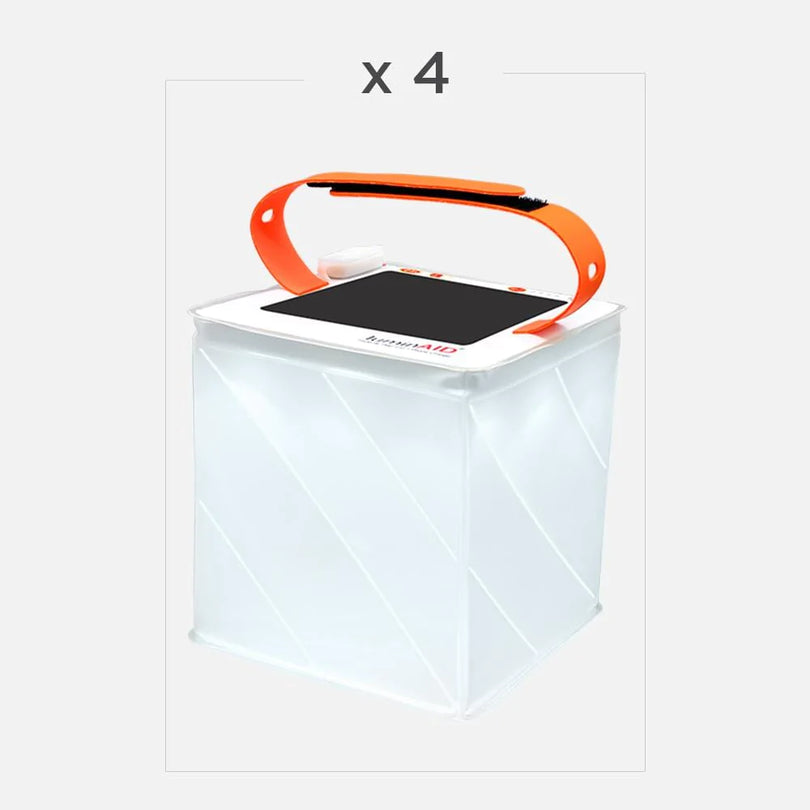
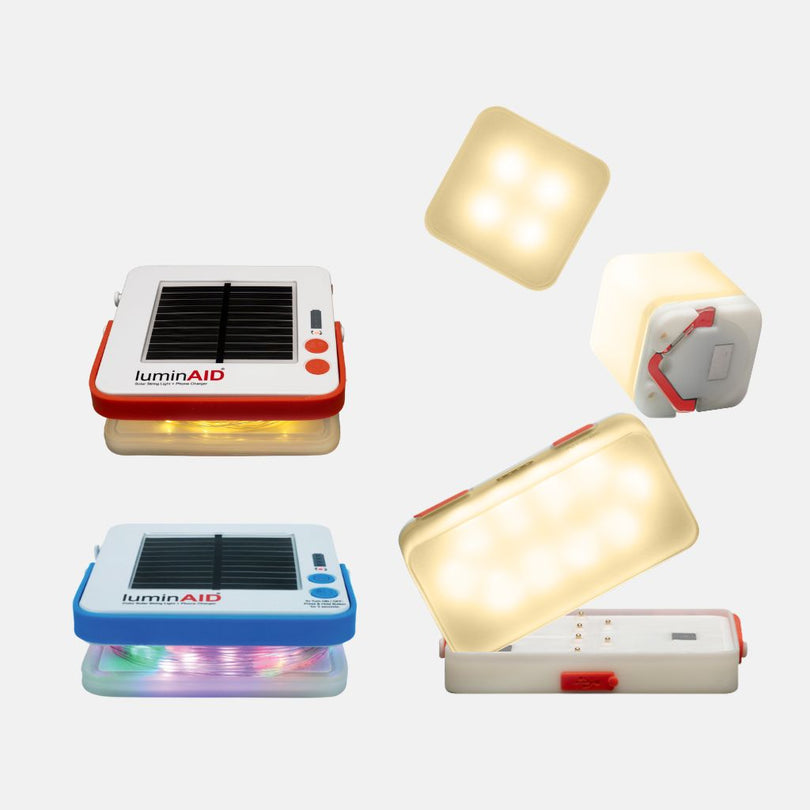
For a homeowner facing a multi-day outage, a mid-size portable power station paired with a small solar panel can keep phones, lights, a router, and a medical device on life-support duty. A portable solar lantern fits that setup well because it handles light without dragging the main battery down. LuminAID's 2-in-1 power lanterns combine a solar lantern with a portable power bank for phone charging, which makes them one practical option among others for this kind of load-focused setup.
For RV and car camping, the logic changes. Space is tight, clutter gets old quickly, and the goal is often to reduce the number of separate chargers and lights. A solar lantern with built-in phone charging can replace a pile of camp lights and keep the cabin calmer at night. Other consumer brands exist for comparison, but the useful question is still the same, which light also helps solve the charging problem.
Backcountry camping is different again. Weight matters more than wall-like output, so lightweight, packable lighting and small USB power banks make more sense than a heavy backup station. Waterproof, easy-to-clip light is the priority, not a big inverter or long runtime.
Disaster relief and community response call for durability and simple deployment. High-output lanterns and string lights help make shelters, staging areas, and field stations less chaotic after dark. FEMA's critical-facility guidance also reminds planners that life-safety loads can include fire alarms, egress lighting, and network equipment, so the lighting package has to serve more than mood or convenience.
The product choice follows the load
The easiest way to avoid overbuying is to separate light, communications, medical, and refrigeration into different needs. A home may need a battery station for the router and CPAP, a solar lantern for room lighting, and a generator only if the outage is long enough to justify fuel logistics.
For example, the Department of Energy notes that fuel-cell backup is mainly aimed at smaller-scale applications (DOE fuel cell backup fact sheet). That helps explain why some systems are built for targeted support instead of whole-house endurance. Backup power gets more effective when the device matches the role, not when the biggest unit wins.
Safety and Maintenance Habits That Keep Backup Power Working
Most backup power failures don't happen because the device was wrong on paper. They happen because the battery sat untouched, the generator was never tested, or the fuel went bad before anyone needed it. Reliability is built during quiet weeks, not during storms.
A monthly habit beats a frantic storm purchase
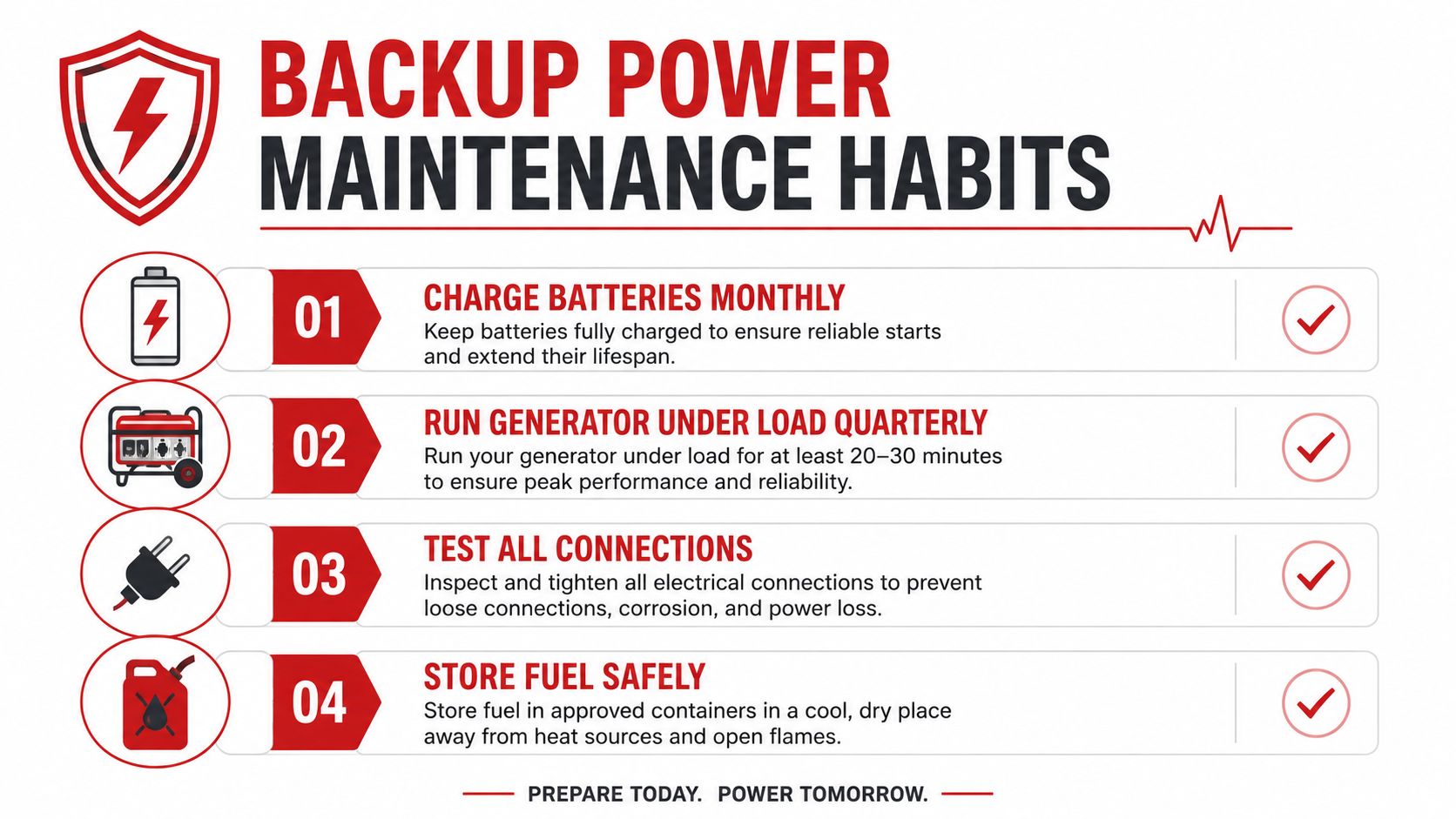
A practical routine is simple. Charge batteries monthly, top off lanterns, test the UPS, and inspect connections before the next outage season arrives. Public preparedness guidance also stresses that battery backups should stay charged and be tested every 30 days, while gas generators need fuel drained or stabilized when not in use, because neglect is what turns a good purchase into dead weight.
Backup systems fail most often at the edges, not the center. A battery that was fine six months ago can be useless now if nobody checked it.
Generator safety deserves its own reminder because it's easy to forget when the weather is bad and the house is dark. Fuel generators should never run indoors or in a garage, and fuel should be stored safely. Batteries should also be kept away from heat, because heat shortens the useful life of gear that's supposed to be there when the lights go out.
The same maintenance mindset applies to outdoor gear and trip planning. A resource like safe backcountry skiing near Bled is a good reminder that preparedness always includes checking conditions, not just carrying equipment. The lesson carries over cleanly to backup power, the system works best when it's tested before the trip, the season, or the storm.
Putting It All Together with Printable Prep Checklists
A good backup plan is small enough to use and specific enough to trust. The right kit isn't the one with the most gear, it's the one that handles the most important roles without creating clutter or confusion.
72-hour home emergency power kit
- Lights: one portable power station or UPS for indoor essentials, plus a solar lantern for room lighting.
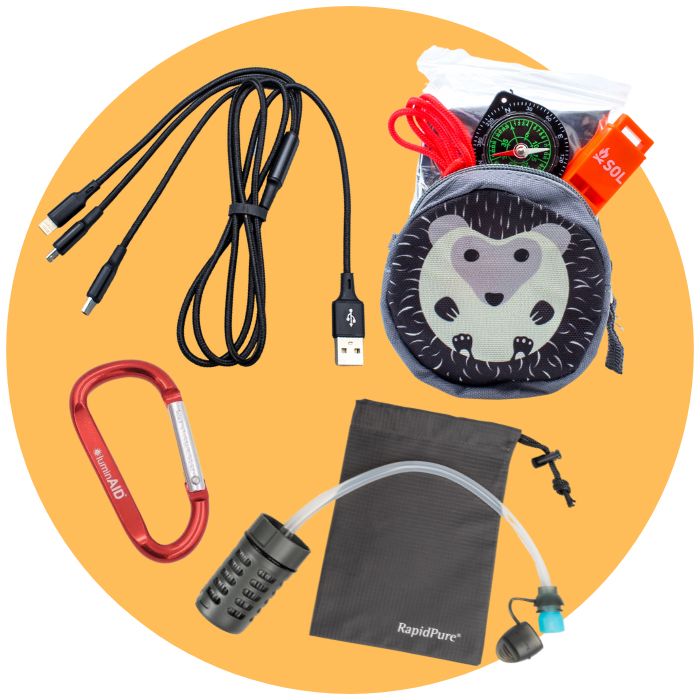
- Communications: charged phones, a USB charging cable set, and a small power bank for the household member who needs to stay reachable.
- Medical: a dedicated outlet plan for CPAP, refrigerated medicine, or other critical devices.
- Refrigeration: a clear rule for the fridge and freezer, what stays plugged in, what gets moved, and what can wait.
- Morale and comfort: one low-glare lantern, a weather radio, and a charging habit that keeps panic from replacing routine.
Grab-and-go bag checklist
- Portable light: a packable lantern or flashlight that can be used immediately.
- Power reserve: a small USB battery for the phone, weather alerts, and family updates.
- Medication and documents: critical items kept together so a fast exit doesn't become a scavenger hunt.
- Cables and adapters: the exact charger the family uses, not the spare nobody remembers.
- Safety basics: first-aid items, gloves, and a written contact list.
For first-aid and outdoor support items, Adventure Medical Kits and Natrapel are useful references for building a broader preparedness bag around the power gear. The power system and the safety kit should be treated as one plan, not two separate purchases.
A few practical questions usually come up at the end. A starter kit can be as simple as a lantern, a small battery, and a charging cord set, while larger home setups add a portable power station or generator depending on the load. A mid-size power station's fridge runtime depends on the fridge's actual draw and the station's usable capacity, so the sizing method above matters more than a generic promise. And no, it is not safe to run a generator in an attached garage, even with the door open.
For readers assembling the rest of their kit, the full line at LuminAID includes portable solar lanterns and 2-in-1 phone chargers that fit the same load-prioritization mindset used throughout this guide. A small, reliable light source can make the whole plan easier to live with, and that's usually what keeps the plan in place when the next outage arrives.
Prepare the household, the RV, or the response bag before the weather does the deciding. Visit LuminAID to look at portable solar lanterns and 2-in-1 phone chargers that fit into real backup plans, then build the rest of the kit around the loads that matter.