



At 11 p.m., a winter outage turns a familiar house into an obstacle course. One adult carries a toddler down an unlit hallway, another searches a drawer for matches, and the only flashlight has dead batteries. The problem isn't a lack of gear. It's a lack of planned, tested redundancy.
A dependable emergency light kit uses several light types across rooms, power sources, and jobs. One light handles a hallway route, another illuminates a kitchen work surface, a headlamp keeps both hands free, and a spare power method prevents a dead battery or missing cable from ending the plan. Ready.gov lists a flashlight and extra batteries among the core contents of an emergency supply kit, alongside supplies for evacuation and power outages (Ready.gov emergency kit guidance).
The useful question isn't “Which flashlight should be bought?” It's “Which light is needed in each room, for which task, and what happens if its power source fails?” That question produces a system instead of a drawer full of untested gadgets.
Table of Contents
- Picture This Before You Pack a Thing
- The Core Gear Every Emergency Light Kit Needs
- Scenario Checklists for Home, Car, and Evacuation
- How Much Light You Actually Need Room by Room
- Why Owning a Flashlight Is Not the Same as Being Ready
- Testing and Maintenance That Actually Prevents Failures
- A One Week Plan to Finish Your Emergency Light Kit
Picture This Before You Pack a Thing
A blackout exposes weak planning within seconds: one flashlight cannot guide a family through a hallway while someone carries a child, checks a fuse box, or prepares food. A lantern in the living room does little for a dark bathroom, bedroom, or staircase. Your kit needs redundancy by room and by task.
Preparedness data shows why ownership alone falls short. A 2018 U.S. study found that 89% of respondents had a working flashlight, but only 46% considered their household prepared for a power outage (household preparedness study). A light in a drawer is not a ready system. Placement, spare power, and hands-free options determine whether it works under pressure.
Build redundancy across rooms
Start with coverage. Put area lights where people move and work, rather than keeping every light in an emergency closet. Bedrooms, hallways, bathrooms, the kitchen, and the main living area may all need usable illumination at once.
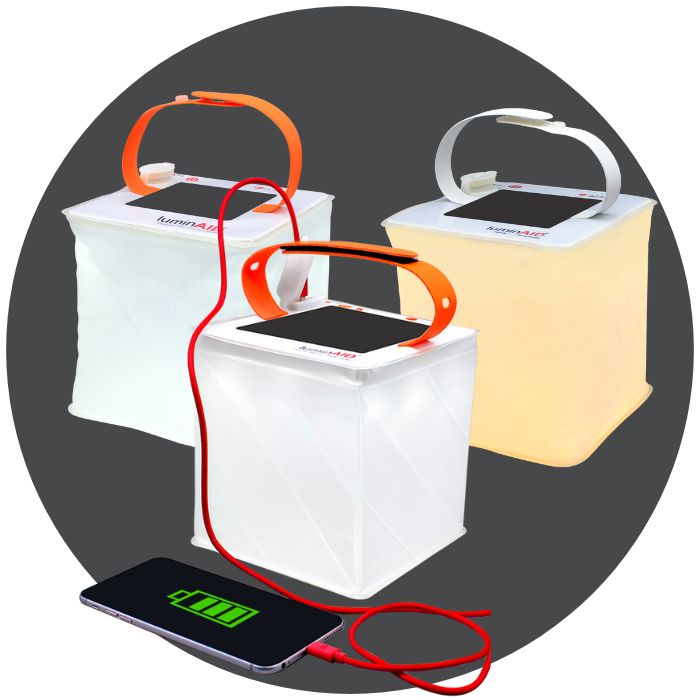
Add power diversity. Rechargeable lights are convenient, but stored charge and a working charging method can both fail. Keep replaceable-battery lights as a separate backup. A packable solar lantern adds another option during a prolonged outage, provided it is charged before storage.
Assign each light a clear role:
- Task lighting supports cooking, first aid, repairs, and carrying children.
- Area lighting spreads usable illumination across a room.
- Route lighting marks hallways, stairs, and bathroom paths.
- Signal lighting helps people locate a vehicle, entrance, or roadside position.
Practical rule: Every occupied room needs a light, and every critical task needs a hands-free option.
Map the rooms first, then assign light types and power sources to each one. Keep the system ready with monthly checks, annual runtime tests, timely battery replacement, and storage locations everyone can find. Testing matters because a light that worked last season may no longer provide useful runtime when the power fails.
The Core Gear Every Emergency Light Kit Needs
Each item should solve a specific failure mode. Brightness alone doesn't make a light suitable for an outage.
Match the gear to the job
Area lanterns provide broad room coverage. An LED camp lantern in the 200 to 400 lumen range suits a kitchen, living area, or shared room, while a lower-output lantern may work for a bedroom. The point is diffusion, not a narrow beam that leaves corners dark.
Headlamps handle hands-free work. A 60 to 150 lumen headlamp is practical for checking a breaker, preparing food, treating an injury, or carrying a child. A red mode helps preserve night vision and reduces glare when someone else is sleeping.
Handheld flashlights belong in the search and signaling category. A focused beam at 200 lumens or more can help inspect a yard, locate a vehicle, or signal from a distance. A handheld shouldn't be expected to replace a lantern because a narrow beam is poor whole-room lighting.
Primary lithium batteries make sense for lights stored for long periods, especially in cars. NiMH rechargeable batteries suit devices used and recharged regularly. Neither chemistry removes the need for inspection, because stored cells and rechargeable packs can still lose useful capacity.
| Category | Primary Role | Typical Lumens | Power Source | Failure Mode It Covers |
|---|---|---|---|---|
| Area lantern | Whole-room coverage | 200–400 | Rechargeable or replaceable batteries | One narrow beam leaves people in shadow |
| Headlamp | Hands-free task work | 60–150 | Rechargeable or replaceable batteries | Both hands are occupied |
| Handheld flashlight | Search and signaling | 200+ | Primary lithium or rechargeable batteries | A lantern lacks reach |
| Automatic outage light | Immediate route lighting | Manufacturer-rated output | Rechargeable battery | People can't find a light during the first seconds |
| Power bank | Device and light charging | Not applicable | Stored electrical charge | Wall outlets are unavailable |
| Hand-crank radio | Information and backup charging | Not applicable | Manual generation | Batteries and grid power are unavailable |
| Packable solar lantern | Evacuation and supplemental lighting | Manufacturer-rated output | Solar and stored charge | No outlet or hanging point is available |
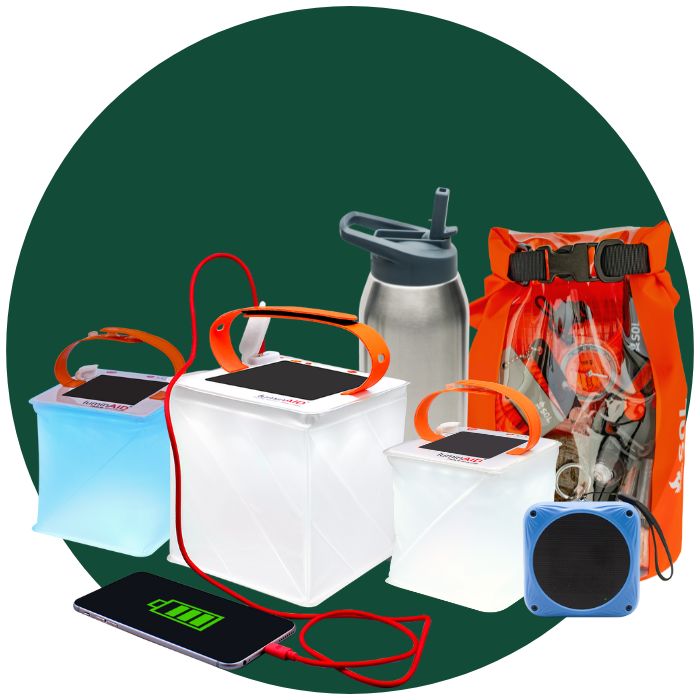
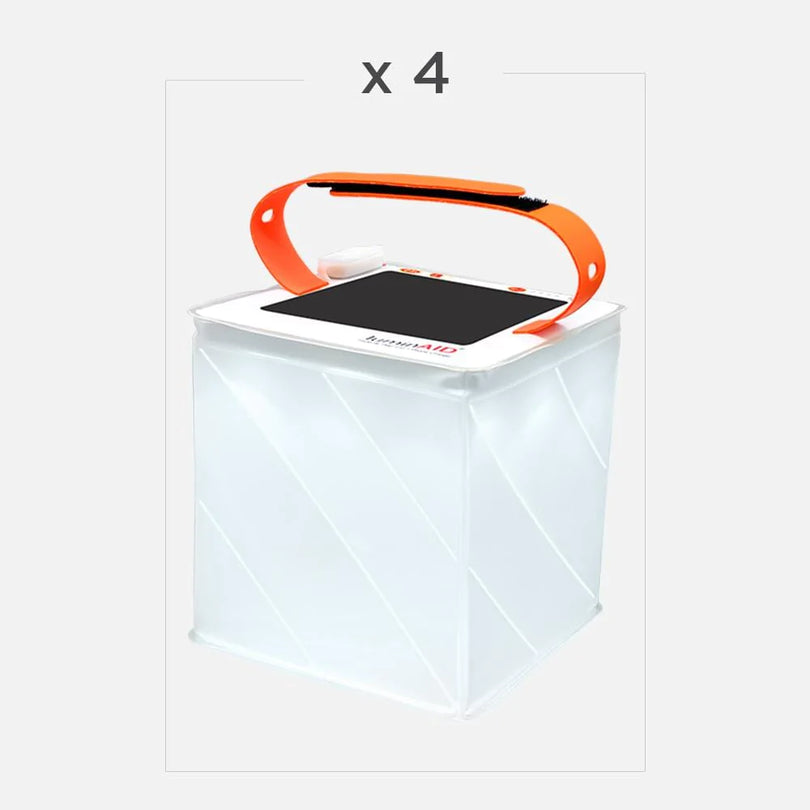
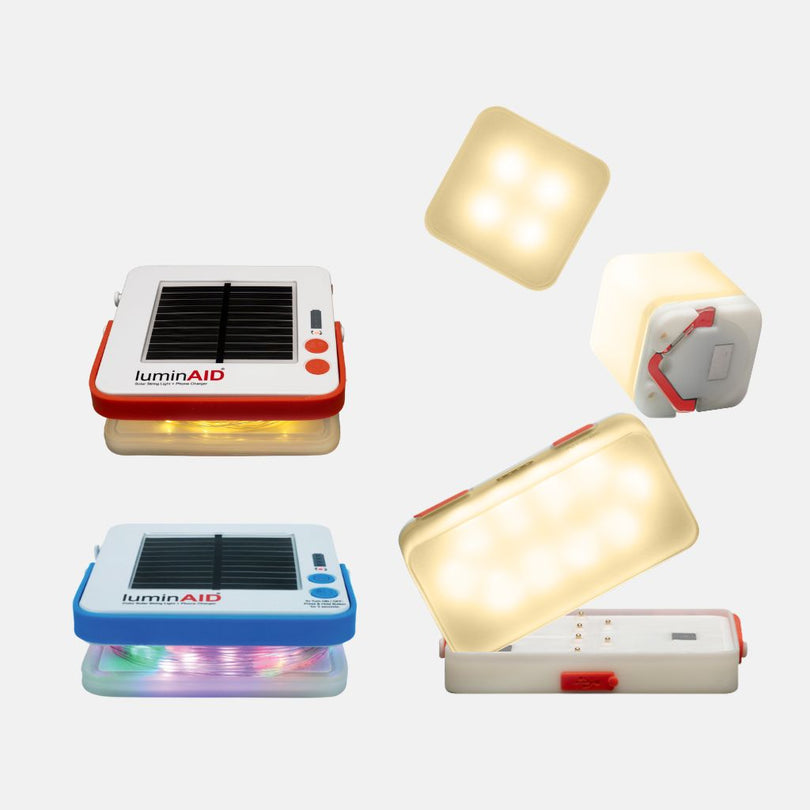
The emergency lighting guide is useful for comparing automatic outage lights, rechargeable designs, and other backup approaches. LuminAID fits as an inflatable, pack-flat solar lantern with phone-charging capability, particularly useful in an evacuation bag or rental home where permanent mounting isn't practical. Non-solar gear still earns space in a vehicle, where a primary lithium light can remain ready without depending on sunlight or a charging setup.
Cover the small failures
A missing adapter can make a rechargeable light useless. A lost lantern can leave one room dark. A light with no hanging point may illuminate only the floor.
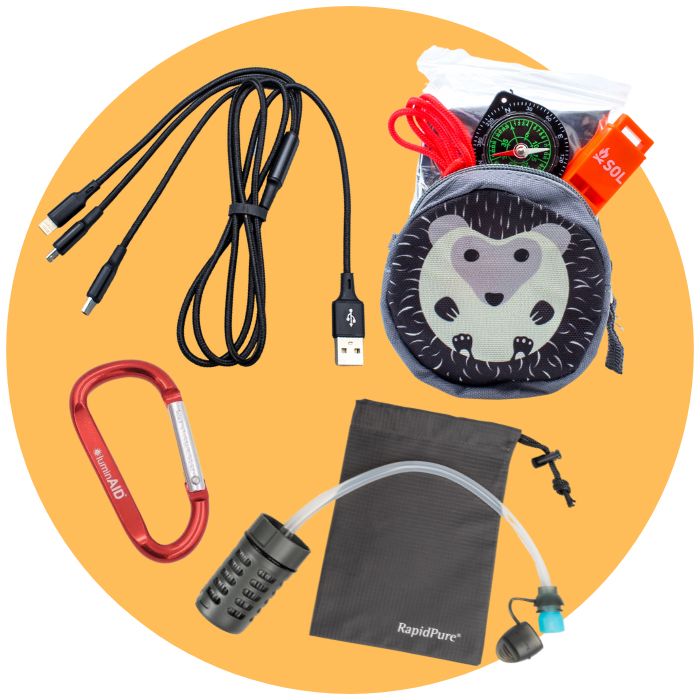
Store charging cables with the device, keep one backup cable in the household kit, and choose at least one light that can stand on its base. A small hook, magnetic mount, or diffuser can matter as much as the lumen rating because it determines whether the light covers the space.
Scenario Checklists for Home, Car, and Evacuation
The right emergency light kit changes with the scenario. A home kit can carry more equipment because weight matters less. A car kit must tolerate temperature swings and vibration. An evacuation bag has to justify every ounce.
| Scenario | Item | Why It Belongs | Watch Out For |
|---|---|---|---|
| Home blackout | Area lantern in each occupied room | Keeps rooms usable without moving one light around | One lantern can't cover simultaneous needs |
| Home blackout | Headlamp for each regular sleeper | Supports hands-free movement and tasks | Store it where it can be found in darkness |
| Home blackout | Charging block near a known outlet | Keeps rechargeable gear staged before an outage | A charging block doesn't help if cables are scattered |
| Home blackout | Spare primary lithium batteries | Provides a separate power path | Check compatibility and dates |
| Home blackout | Written breaker list | Helps identify circuits without searching in the dark | Update it after electrical changes |
| Car kit | Heavy-duty handheld flashlight | Supports inspection and signaling | Don't substitute a small indoor light |
| Car kit | Chemical light sticks | Adds visible roadside marking without batteries | They provide limited task illumination |
| Car kit | 12V USB adapter | Offers an in-vehicle charging route | It depends on vehicle power |
| Car kit | Blanket | Helps protect occupants and preserve phone battery in cold conditions | It doesn't replace a power bank |
| Evacuation bag | Pack-flat solar lantern | Adds low-weight area lighting without an outlet | Store it charged and protected from moisture |
| Evacuation bag | Compact headlamp | Keeps hands free while walking or organizing gear | Avoid unnecessary bulk |
| Evacuation bag | High-output handheld | Provides a stronger search and signaling beam | It consumes more power |
| Evacuation bag | Primary lithium cells | Offers long storage suitability | Don't mix old and new cells |
| Evacuation bag | Dry bag | Protects lights and batteries from moisture | It adds weight, so size it to the load |
A practical emergency lighting checklist can help households identify missing categories without turning the process into a shopping spree.
The car deserves special treatment. Solar charging is unreliable inside a vehicle during bad weather or nighttime, so the vehicle kit should rely on stored batteries and a 12V option. The evacuation bag has the opposite priority: low weight, compact storage, and multiple ways to make light.
Families should scale the list to their layout and occupants. A household with young children needs more room coverage and hands-free lighting. A renter may prioritize pack-flat lights and avoid fixtures requiring installation. A household in a storm-prone area should give more attention to spare power and moisture protection.
How Much Light You Actually Need Room by Room
Lumen labels help only when they're matched to a task. A hallway needs enough light to identify a route and obstacles. A kitchen needs more useful illumination on a counter, while a stairway needs beam coverage that reaches steps without producing harsh glare.
An expert emergency-lighting guide gives a practical range of 20 to 50 lumens for a hallway or bedside route, 100 to 300 lumens for general room lighting, and 200 to 1,000 lumens for cooking, first aid, repairs, or outdoor inspection (room-specific emergency lighting guidance). Those ranges work better as planning bands than as rigid purchase rules.
| Room | Lumen Target | Beam Type | Recommended Power Source |
|---|---|---|---|
| Hallway | 20–50 | Soft, wide beam | Automatic or rechargeable light |
| Bedroom | 50–100 | Diffused area beam | Rechargeable or replaceable battery |
| Bathroom | 50–100 | Wide beam with low glare | Replaceable battery or rechargeable light |
| Kitchen | 200–400 | Broad area plus focused task beam | Rechargeable lantern with battery backup |
| Stairway | Enough throw to cover the full route | Downward and forward coverage | Independent light source near the stairs |
| Outdoor inspection | 200–1,000 | Focused throw | Primary lithium or rechargeable handheld |
These consumer targets don't replace building-code requirements for installed egress systems. Emergency egress guidance commonly specifies 90 minutes of runtime, average initial illumination of 1.0 footcandle, or 10.8 lux, and no point below 0.1 footcandle, or 1.1 lux, on exit routes (emergency lighting code planning). Portable household lights aren't automatically compliant egress systems, so commercial or regulated installations need qualified assessment.
A quick sizing exercise takes a floor plan and three questions. Mark every room occupied during an outage, mark every route to an exit, and mark every task area where food, medicine, or tools may be handled. Assign a low-output route light, a room light, or a task light to each mark, then check whether any single device is responsible for two critical locations.
Why Owning a Flashlight Is Not the Same as Being Ready
A working flashlight helps, but it does not make a household ready for a blackout. Ownership rates are high, yet the gap between owning a light and using it effectively during a real outage is where many households fail. One device cannot cover placement, hands-free work, room coverage, backup power, and safe movement at the same time.
A drawer flashlight can fail in several ordinary ways:
- The battery has been neglected. The light worked during the last test, but the cells leaked or lost charge afterward.
- The household depends on one device. One missing flashlight leaves everyone else searching in darkness.
- The light requires one free hand. Cooking, carrying a child, opening a door, or treating an injury becomes harder.
- The beam doesn't fit the room. A focused handheld may illuminate a countertop while leaving the rest of the kitchen dark.
- The device isn't stored where the outage begins. A light inside a distant closet is less useful during the first minutes of a blackout.
Keep the flashlight, then give it a defined job. Add a headlamp to task supplies, an area lantern to the main living space, and a route light near the bedroom or stairs. Store spare batteries with each device, not in an unrelated drawer. Redundancy matters because one dead battery, misplaced light, or occupied hand should not leave a critical area dark.
A flashlight is equipment. Preparedness is equipment plus placement, power, and practice.
Outage duration also changes the standard. A light that works for a quick check may fail during hours of cooking, medication, childcare, or movement between rooms. Plan for the household to use several light sources without relocating the only working device.
Run one 15-minute blackout drill this week. Turn off the usual lights, use only the kit, and record every room where a light was missing, unreachable, too dim, or impossible to operate hands-free. Fix those gaps before the next outage.
Testing and Maintenance That Actually Prevents Failures
A light kit is only dependable when its performance is documented. Batteries age in storage, rechargeable packs lose capacity, connections loosen, and a device can still turn on while falling short of its rated runtime. Maintenance should test the kit's redundancy, not merely confirm that one bulb works.
Emergency lighting is commonly designed to energize within 10 seconds of power loss and maintain illumination for at least 90 minutes, according to emergency-light maintenance and testing guidance. Use that benchmark for applicable equipment. The same guidance recommends monthly 30-second functional tests and annual 90-minute discharge tests. Installed life-safety systems may follow local requirements, so facility managers should use the applicable standard and retain records.
Use a simple maintenance rhythm
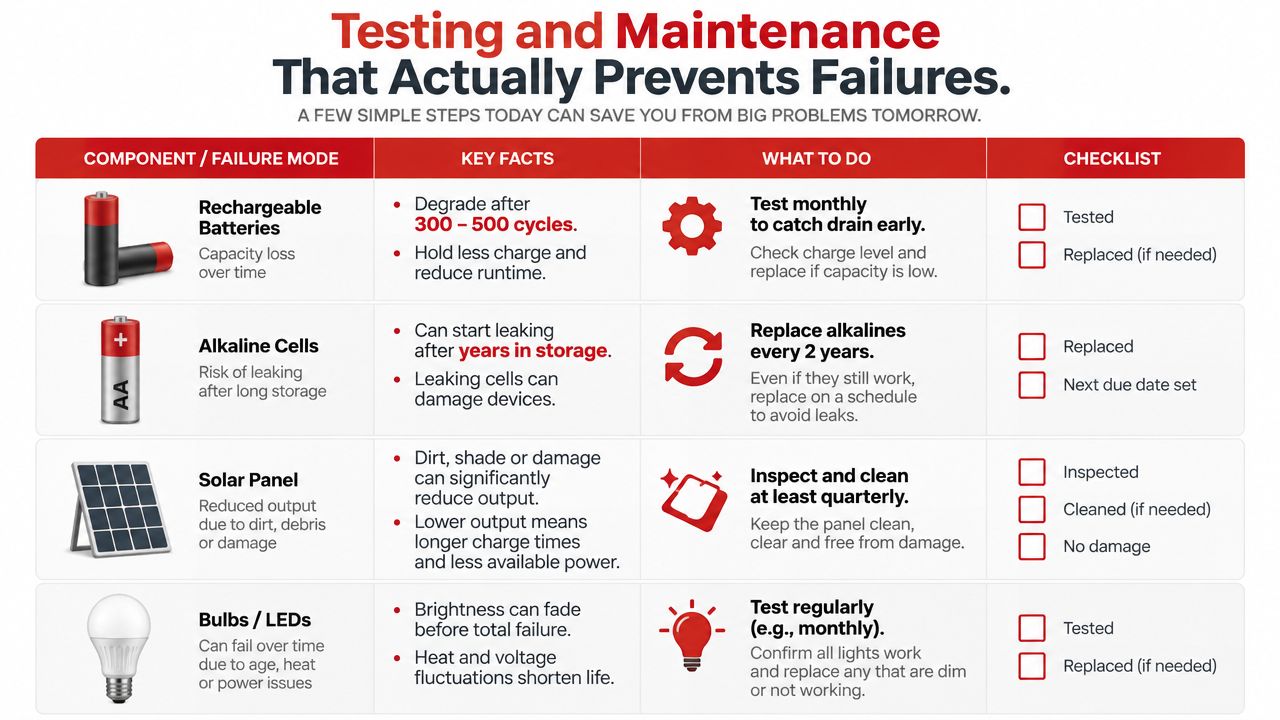
Each month, press the test button on every light and confirm immediate illumination. Check indicators and battery compartments for corrosion. Verify that headlamps, lanterns, and flashlights remain in their assigned locations, so room-by-room coverage does not develop unnoticed gaps.
Each quarter, run a controlled runtime check on rechargeable devices and representative battery-powered lights. A unit that switches on but fades too quickly cannot support its assigned task.
Each year, complete a full 90-minute discharge test on equipment intended for that runtime. Recharge it, record the result, and replace batteries before the device drops below its required runtime.
A field study cited by The Watt Digest found that 37% of units passing annual tests failed within 47 days of a later outage, demonstrating why a visual check alone is insufficient. Battery aging accounts for roughly 45% to 60% of cited failures, and useful battery life is often only 2 to 5 years rather than the nominal rating, according to that source.
Track the failures people miss
Neglected emergency-lighting fleets can show 20% to 30% of luminaires failing annual duration tests, while 5% to 10% may fail during inspections before a full outage. Wiring or loose connections account for 15% to 20% of failures in another dataset, and visual checks may miss those problems, according to emergency lighting failure prevention guidance.
Use labeled bins for home, car, and evacuation equipment. Tape a one-page inventory card inside the main container with each light, battery type, last test date, and replacement date. Set a calendar reminder, then follow it.
Retire batteries showing swelling, corrosion, leakage, or clear runtime loss. Rechargeable batteries can degrade after 300 to 500 cycles, according to battery lifespan guidance, while alkaline cells can leak after years in storage. Rotate stock before either problem leaves a room without coverage. Inspect solar panels and recharge them periodically instead of storing them depleted.
A One Week Plan to Finish Your Emergency Light Kit
A finished kit doesn't require a month-long project. Seven focused sessions can turn scattered lights into a documented system.
Day 1, inventory. Gather every flashlight, lantern, headlamp, battery, charger, and power bank. Test each item, remove dead or damaged equipment, and write the remaining inventory on one sheet.
Day 2, map the rooms. Mark bedrooms, bathrooms, hallways, stairs, kitchen work surfaces, exits, and the main living area. Assign room and route targets using the lumen ranges above.
Day 3, fill the gaps. Buy only what the map shows is missing. Prioritize area coverage, hands-free lighting, spare primary lithium batteries, and one packable solar option for evacuation use.
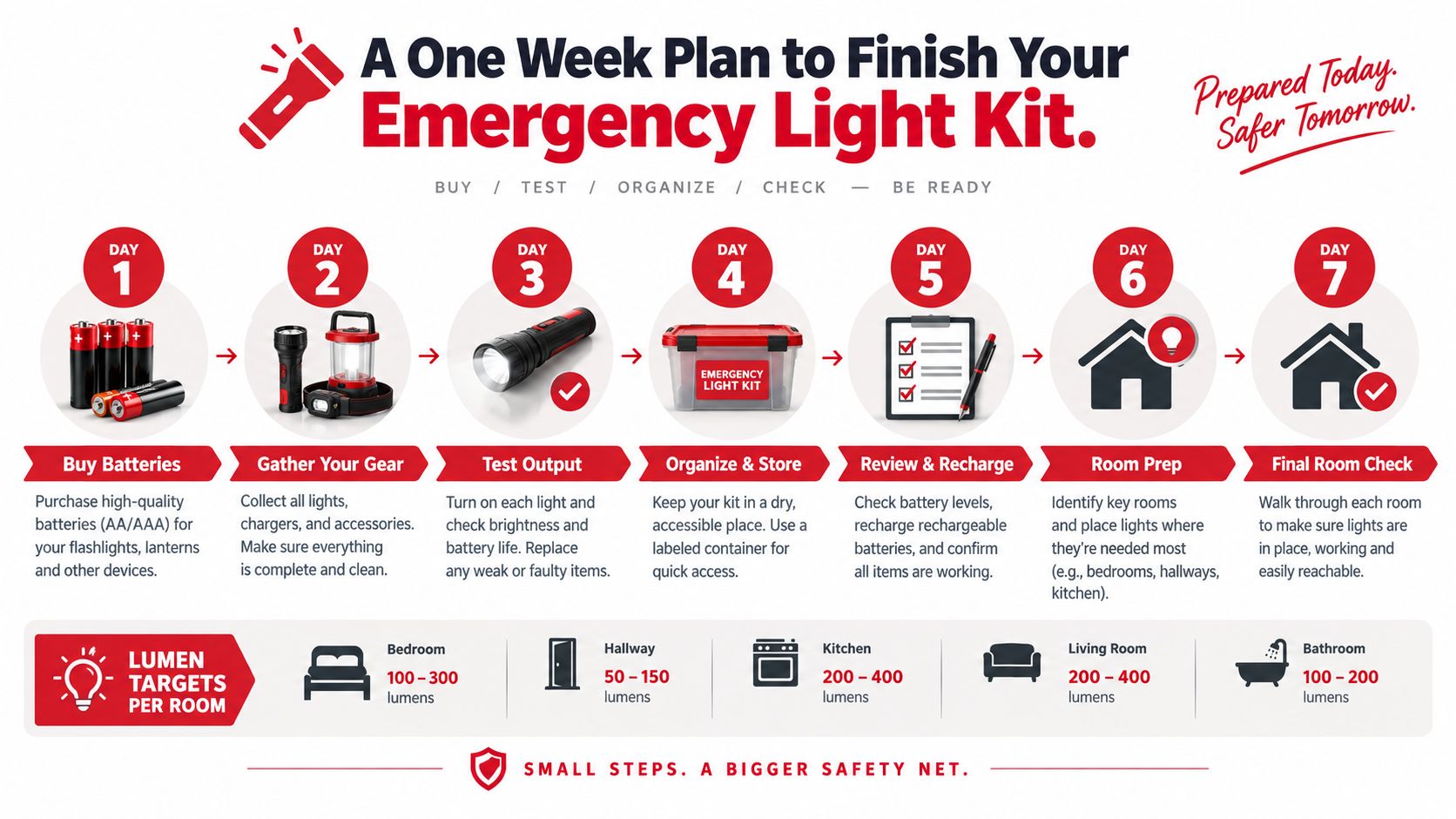
Day 4, pack scenarios. Build the home station, car kit, and evacuation bag separately. Add the heavy-duty handheld and chemical light sticks to the car, then keep the lightweight lantern, headlamp, handheld, lithium cells, and dry bag together for evacuation.
Day 5, label locations. Mark storage zones clearly. Place lights where the outage will be experienced, not where they look tidy. Keep charging blocks and cables beside the devices they support.
Day 6, run the drill. Simulate a blackout and test the home system for 90 minutes. Walk the routes, prepare a simple task in the kitchen, check the bathroom, and record every failure or inconvenient placement.
Day 7, correct and schedule. Move lights, replace weak batteries, recharge devices, and inspect every room again. Set phone reminders for monthly button tests, quarterly runtime checks, and annual full-duration testing.
The printable summary belongs inside the storage closet:
- Core gear: area lanterns, headlamps, handheld flashlights, spare batteries, charging blocks, and power redundancy.
- Home subset: one area light per occupied room, route lighting, headlamps, and a breaker list.
- Car subset: heavy-duty handheld, chemical light sticks, 12V adapter, blanket, and stored batteries.
- Evacuation subset: packable lantern, compact headlamp, handheld, primary lithium cells, and dry bag.
- Maintenance: monthly function checks, quarterly runtime checks, annual 90-minute discharge tests, and dated battery rotation.
LuminAID offers packable solar lanterns and 2-in-1 phone chargers that fit the evacuation and backup-power layers of an emergency light kit. Families can review the available options and choose a light that matches their room coverage and portability needs at LuminAID.