

A winter storm warning can change an ordinary evening quickly. Roads become unsafe, stores close, and a power outage can leave a household without heat, lighting, reliable phone service, or a way to charge devices. A useful blizzard emergency kit is more than a box of supplies: it's a coordinated plan for staying informed, warm, and safe at home, on the road, or while relocating.
Table of Contents
- Why a Blizzard Emergency Kit Needs More Than Supplies
- Choose the Right Kit Layers
- Pack Each Kit in a Practical Order
- Coordinate Light, Power, Weather, and Warmth
- Customize the Kit for People, Pets, and Homes
- Test, Pack, and Maintain the Kit
- Finish With a Storm-Day Readiness Routine
Why a Blizzard Emergency Kit Needs More Than Supplies
Blizzards can disrupt several essentials at once. A stocked pantry won't help much if the house is dark, the phone battery is nearly empty, and nobody can check the forecast. A sound plan accounts for food, warmth, lighting, communications, and power together, so one failure doesn't leave the household without another way to respond.
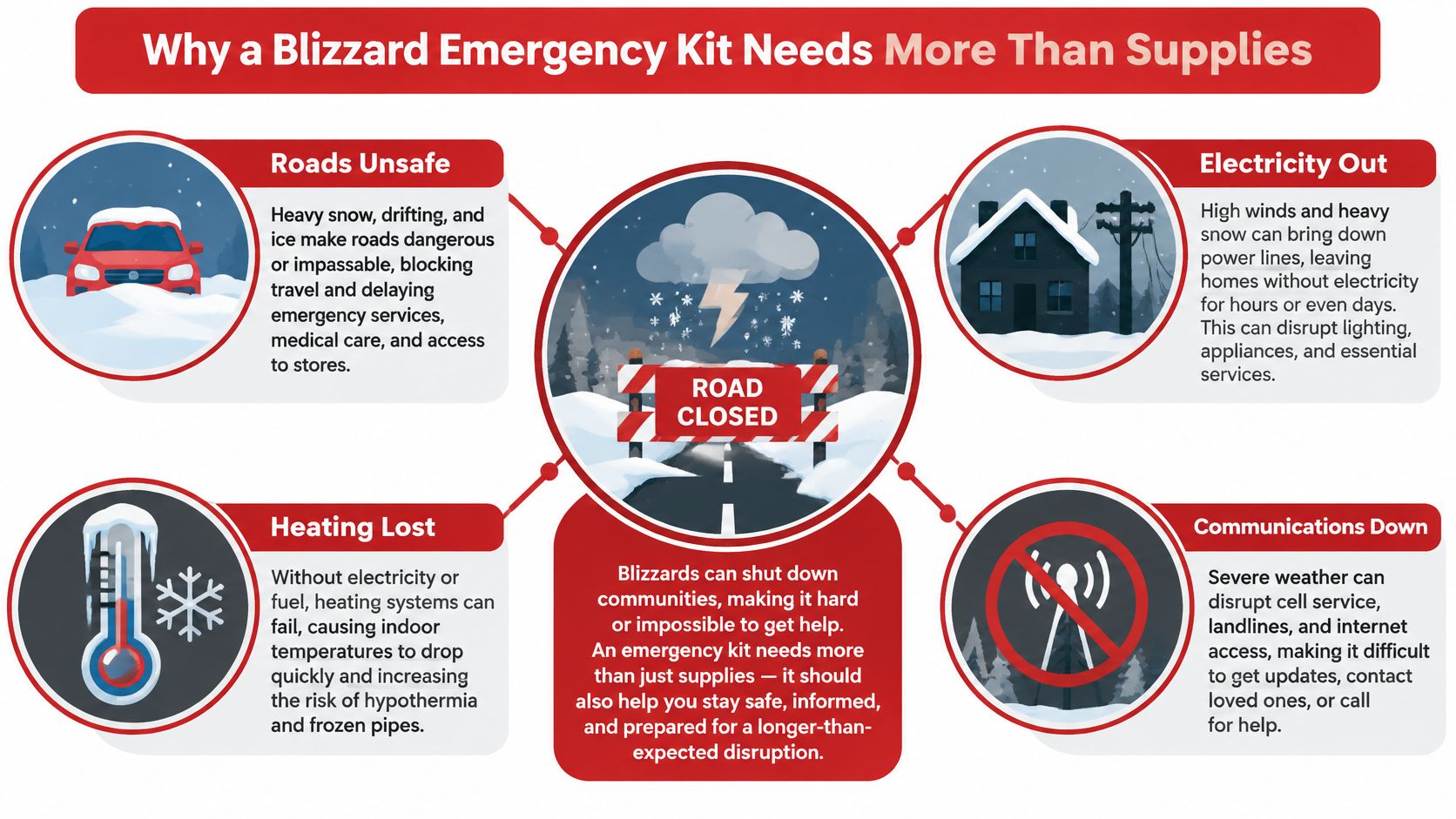
The scale of past storms shows why a kit should support more than a brief snowfall. During the December 21–26, 2022 winter storm, more than 200 million people were under a winter-weather advisory or warning, while more than 1 million electricity customers from Texas to Maine lost power, according to NOAA's U.S. billion-dollar disaster records. Those conditions can make ordinary routines unavailable for days.
That's the difference between an outage response and a multi-day emergency plan. The first may cover a short period without electricity. The second prepares people to shelter safely while roads remain impassable or utilities take time to return. The National Weather Service recommends being prepared to remain at home for several days, with supplies that don't depend on cooking or refrigeration.
Practical rule: Plan for the services a household normally relies on to fail together, not one at a time.
Start with drinking water, shelf-stable food, prescriptions, warm clothing or blankets, and first-aid supplies. Add independent lighting, phone-charging capability, and a battery-powered or hand-crank weather radio. These items serve different purposes: the radio can provide weather information without mobile data, while a separate light source keeps essential rooms usable if the power goes out.
A kit also supports better decisions. Reliable information helps people avoid unnecessary travel, conserve phone power, and decide whether it's safe to stay home. The objective isn't to predict every problem. It's to keep basic needs covered while normal services are disrupted.
Choose the Right Kit Layers
A single container is easy to picture, but often awkward to use. Supplies for a home outage don't all belong in a car, and a car kit may be too bulky to carry if someone needs to relocate. Build around three layers, each with a clear job and a sensible storage location.
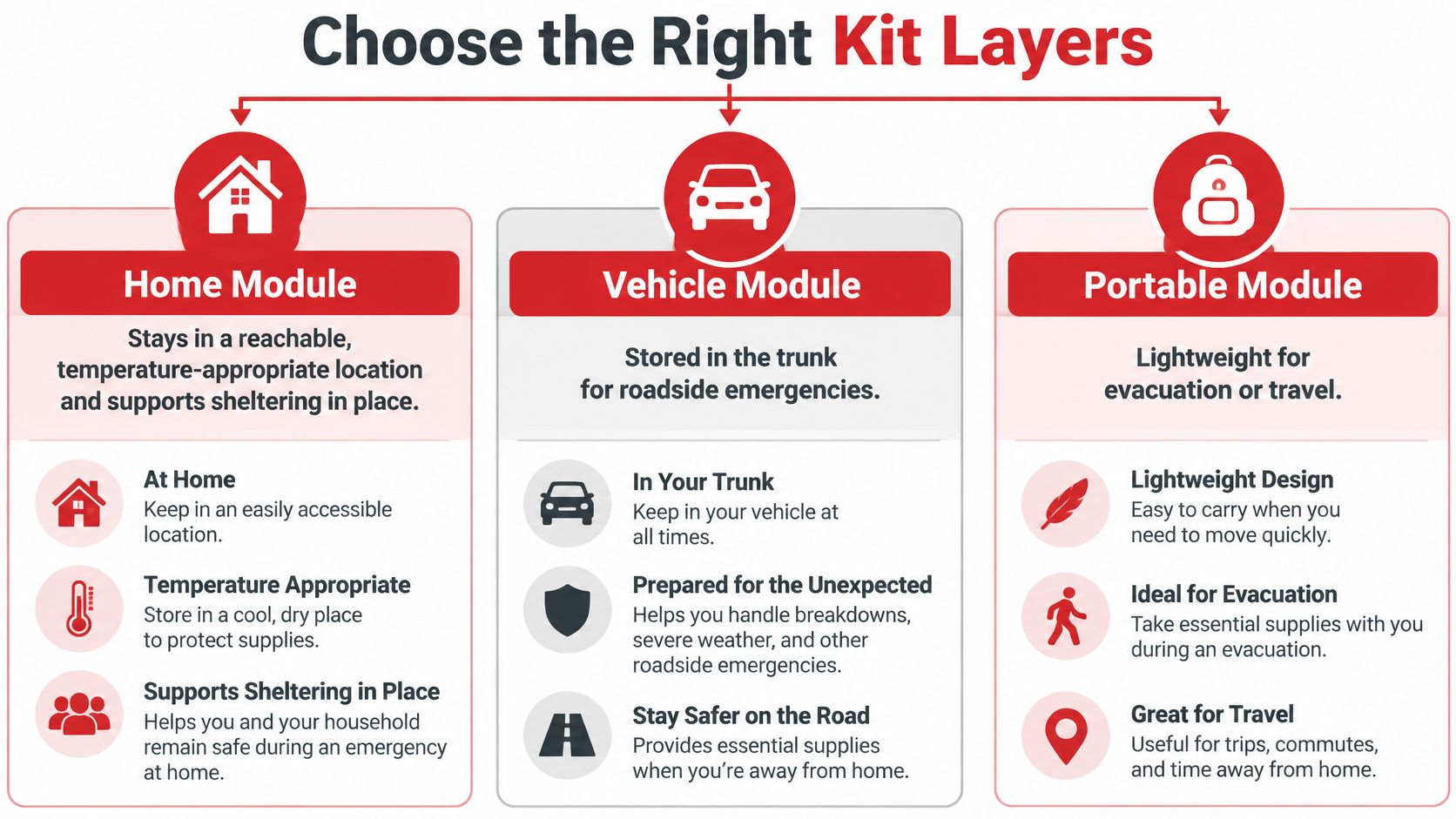
| Module | Purpose and location | What it needs to do |
|---|---|---|
| Home | Store it somewhere accessible without electricity or a trip through snow. | Support sheltering in place with food, water, medicine, light, and weather information. |
| Vehicle | Keep it secured in the trunk or cargo area. | Help people stay visible and warm if a trip is unavoidable and travel is interrupted. |
| Portable | Pack it so one person can carry it when leaving quickly. | Keep immediate essentials together for relocation or travel. |
The home layer can hold heavier supplies and backups that would be impractical to carry. The vehicle layer should focus on roadside needs rather than duplicating the entire pantry. The portable layer needs a different test: Could a household member carry it while wearing winter clothing? If not, reduce bulky duplicates and keep the most essential items easy to grab.
Size portable supplies for each person's needs, including daily medicine, warm clothing, and communication information. Use clear labels on containers and group items by task, such as lighting or medical supplies, so a person can find them in low light. Don't assume every household has a garage, fireplace, generator, or spare room. An apartment resident might keep the home module in a hall closet, while an RV user may need to make sure supplies remain reachable even if the vehicle is parked or winterized.
The National Weather Service's advice to prepare for several days at home makes the home module the foundation, not an optional extra. The vehicle and portable layers address different situations; neither substitutes for the other. A household that doesn't drive in winter may need only a minimal vehicle kit, while someone who regularly travels rural roads may need to give that module more attention.
Pack Each Kit in a Practical Order
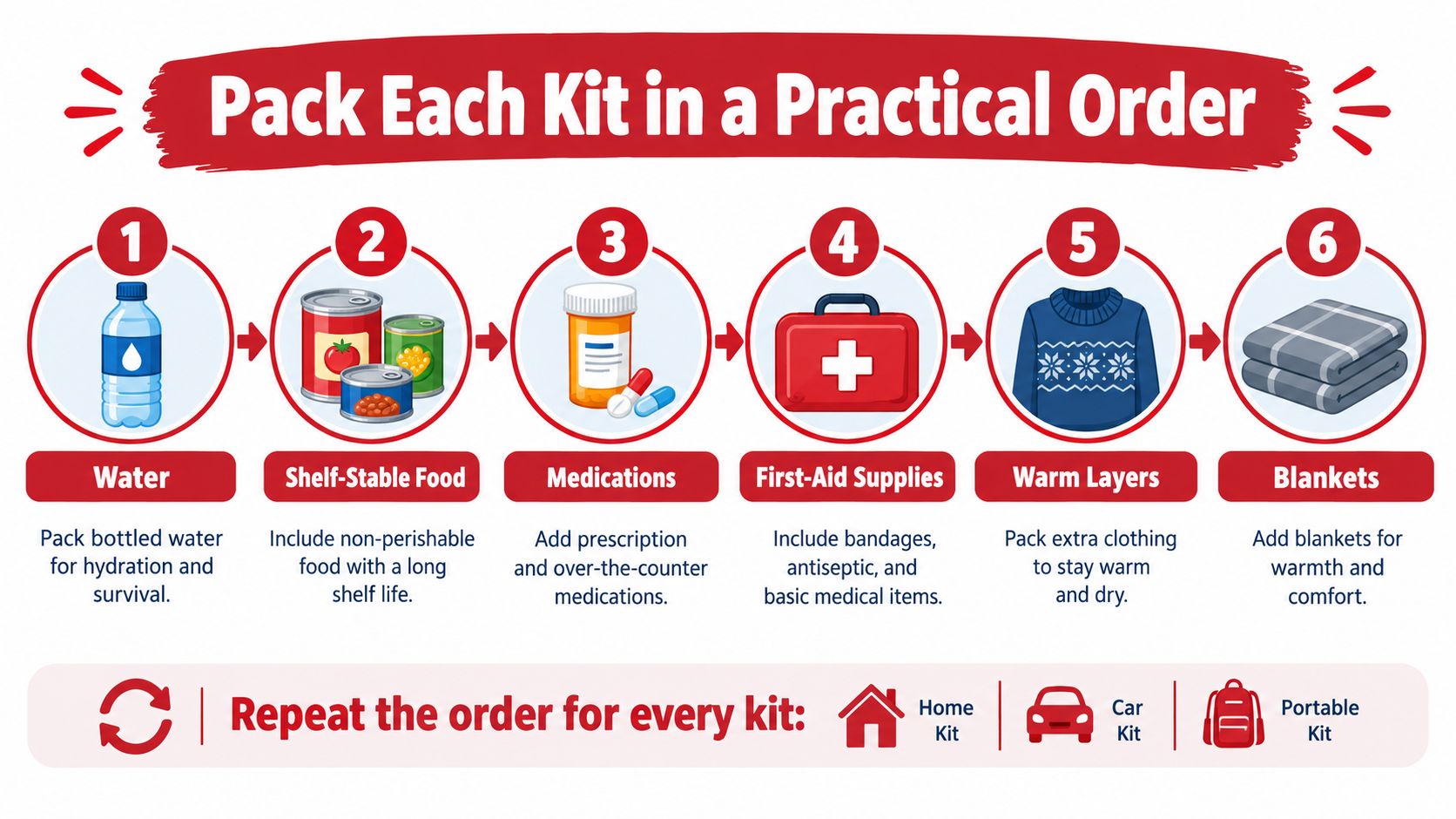
Packing in a fixed order makes omissions easier to spot. Start with the supplies people need to drink, eat, take essential medicines, treat minor injuries, and stay warm. Then add the equipment that supports light, information, and communications.
Build the home module first
- Water and food: Store drinking water and foods that can be eaten without cooking or refrigeration. Include a manual can opener if cans are part of the plan. A tin of food is of little use if the opener depends on electricity or is missing.
- Medications and first aid: Pack regularly needed medicine and a first-aid kit. Keep critical medical information and backup contact details with the supplies, in a format that's accessible without a phone.
- Warmth: Add dry spare clothing, blankets, and layers that can be worn indoors. Wet clothing increases cold exposure, so dry replacements matter even when the household expects to stay inside.
- Information and light: Pack a battery-powered or hand-crank weather radio, a flashlight or lamp, and spare batteries. Keep batteries available separately rather than storing the only backup inside the only light.
- Power and navigation: Add a charged power bank and the correct charging cables. Keep a paper road map and compass as backups; the National Weather Service advises against relying on a phone alone for communication or navigation.
- Comfort: Finish with items that remain usable without a stove or refrigerator, such as familiar snacks or activities for children.
For a household module, keep the frequently needed items near the top of the container. Put documents and spare cables in a labeled pouch. Store the kit where it's reachable without going through a garage, shed, or basement that drifting snow or a power failure could make difficult to access.
Keep the vehicle kit focused
A car kit should help occupants manage a roadside delay, not carry a second household stockpile. Include warm clothing or blankets, water, a flashlight, first-aid supplies, a road map, and a copy of emergency contacts. Add supplies that improve visibility and assist with traction or clearing snow, such as a reflective warning item, scraper, and sand or another traction aid suited to the vehicle and route.
Secure loose items so they don't shift while driving, and keep essentials reachable without unloading the trunk. Store liquids and equipment with freezing conditions in mind, and check the vehicle kit separately from the home supplies. A car module that's packed but buried under luggage isn't ready to use.
Coordinate Light, Power, Weather, and Warmth
During an outage, households need a sequence for using energy, not just a pile of charged devices. Charge phones and power banks before the storm, keep cables together, and decide which phone is reserved for emergency contact. Use independent lights in the rooms where people will gather and move around, rather than depending on one flashlight that can be misplaced or left without working batteries.
Keep a weather radio ready to receive updates without depending on home internet or a charged smartphone. The National Weather Service's winter safety guidance reports that cold-weather-related power outages were 97% higher in 2014–2023 than in 2000–2009, while the longest annual outage affecting U.S. utility customers averaged 12.8 hours in 2025. Those figures make backup light and power practical household needs, not just add-ons for outdoor trips.
Use stored energy first
A solar lantern or solar charger can provide off-grid light or help recharge a phone, but winter sunlight shouldn't be treated as guaranteed power during the first night of a storm. Charge solar-capable devices ahead of time, then treat sunlight as a possible way to replenish energy if conditions improve. Stored energy is the first-night plan; solar replenishment is a backup.
Battery-powered lighting is preferable to open flames during an outage. Keep lights where they're easy to reach, and avoid using candles or improvised lamps as a substitute. A compact light that can be set on a table or hung in a room frees hands for preparing food, checking on family members, and locating supplies. A home emergency light kit guide can help households think through where backup lighting belongs and which activities need it.
Heating needs its own safety check. Test smoke and carbon-monoxide alarms before winter weather threatens, and follow the instructions for any fireplace, stove, generator, or alternate heat source. Never use a generator or fuel-burning device indoors or in an enclosed area. Keep the weather radio and charging setup away from heat sources and water, and avoid opening the refrigerator repeatedly so food stays cold longer.
For a visual overview of household storm preparedness, watch the video below.
Customize the Kit for People, Pets, and Homes
A household kit should reflect who will use it and where they live. Children and older adults can be especially vulnerable to frostbite and hypothermia, and government winter guidance recommends planning for both sheltering in place and evacuation. That means preparing supplies and making a realistic decision about when the home may no longer be safe.
| Household situation | Extra planning focus | Pack or confirm |
|---|---|---|
| Infants and children | Feeding, warmth, comfort, and familiar routines | Baby-care supplies, child-sized warm layers, and no-cook foods suitable for the household |
| Older adults or mobility needs | Safe movement, medicine access, and a way to receive alerts | Mobility aids, extra necessary medicine, accessible light, and backup contact information |
| Medical-device dependence | Whether equipment can operate if power fails | Device power needs, charging options, and an early relocation plan if backup power isn't dependable |
| Apartment or rental home | Building access, shared heating, and a practical place for supplies | Reachable storage, accessible exits, and a plan for getting help or relocating |
| RV or small dwelling | Limited storage and safe, reliable heat | Compact supplies, working alarms, and a clear plan if indoor conditions become unsafe |
| Pets | Food, water, medication, identification, and transport | Pet supplies, leash or carrier, identification, and a safe way to bring the animal along |
Keep medication in its original packaging when practical and follow the storage instructions, especially if the home may become cold. A household member who uses a powered medical device should know how long available backup power can support it and where to go if it can't. If a dwelling is losing safe indoor warmth, exits are blocked, or necessary medical equipment can't remain available, leaving early may be safer than waiting for travel conditions to deteriorate.
Pets need more than a bowl of food. Store their medication, identification details, and a leash or carrier with the portable supplies. Familiar rewards can help make handling or loading less stressful; dog treats from Joyfull can be included if they suit the pet's diet. For people, a family emergency communication plan can help keep contact details and meeting arrangements available if phones fail.
The right choices vary by household. A renter without alternate heat may need a stronger relocation plan than a homeowner with safe, tested heating equipment. A household with a pet, an infant, or a powered medical device should pack and plan around those specific needs instead of relying on a generic list.
Test, Pack, and Maintain the Kit
A kit can look complete and still fail when someone reaches for it. Dead batteries, expired food, missing medicine, and inaccessible storage can turn a prepared household into an unprepared one. Set a recurring check before each winter season, after the kit is used, and whenever supplies are removed.
Run the same inspection each time
- Lighting: Turn on each flashlight or lamp. Confirm that backup batteries are stored separately and fit the devices.
- Radio: Test reception and confirm the radio has a working power source.
- Food and water: Check packaging and dates, and replace anything that's been opened, damaged, or made unusable.
- Medicine and infant supplies: Review what the household needs, then replace items that have been used or are no longer suitable.
- First aid: Check that the kit is intact and its contents remain usable.
- Documents and contacts: Confirm that important information can be found without a phone or internet connection.
- Storage: Make sure the kit remains reachable if the usual route to it is blocked by snow or darkness.
Consider a household that discovers during a power cut that the spare batteries are stored inside the only flashlight, which no longer works. A second light source changes the situation: one person can illuminate the room while another retrieves supplies and checks the radio. That backup is useful only if it has been tested and stored separately.
Keep containers labeled and group small items in pouches so people can find them without emptying the whole kit. Avoid storing everything in one location if one part of the home could become inaccessible. After a storm, note what the household used and replace it promptly, while the gaps are still easy to remember.
Finish With a Storm-Day Readiness Routine
Before a forecast becomes urgent, make the plan concrete. Confirm that the home, vehicle, and portable modules are where household members expect them to be. Charge phones and power banks, check the forecast and weather-radio operation, and make sure the vehicle kit stays in place if travel can't be avoided.
Check smoke and carbon-monoxide alarms, review safe heating arrangements, and agree on what would prompt an early move to safer shelter. Households with mobility needs, pets, or powered medical equipment should know who will help and what needs to travel. The decision to stay or leave should account for the home's actual heating, access, and power situation, not just the forecast.
A blizzard emergency kit works best as a coordinated system: information, warmth, food safety, light, and power. Save or print the maintenance checklist, then use it before the next winter storm. The winter weather safety guide can also support a final review of household readiness.
LuminAID offers portable solar lanterns and phone-charging lights that can be included in a home or travel emergency kit. Visit LuminAID to explore lighting options for winter outages and other off-grid needs.